
Updated on 20-Nov-2026
What if your attempt to clean up that patch of black mould is actually the very thing launching millions of toxic spores into your children’s bedrooms?
It is a common mistake. Most homeowners believe they are helping by vacuuming visible growth, but standard household machines often lack the filtration necessary to trap microscopic particles.
Instead of cleaning, they exhaust spores back into the air, turning a small patch of mould into a whole-home air quality crisis.
Professional HEPA vacuuming mold removal is not just a cleaning step; it is a critical containment strategy designed to stop this invisible spread in its tracks.
We understand the anxiety that comes with finding fungal growth in your Toronto home. You want it gone fast, and you want it done right to protect your pets and family.
This guide explains why the latest ANSI/IICRC S520-2024 standards require True HEPA filtration, which captures 99.97% of particles as small as 0.3 microns.
You’ll learn the mechanical differences between “HEPA-style” and professional-grade equipment, alongside the “HEPA sandwich” technique used by experts to ensure total remediation.
We’ll show you how to restore your home to a safe, breathable environment without the risk of cross-contamination.
Table of Contents
Key Takeaways
- Learn why standard household vacuums act as “spore spreaders” by exhausting microscopic particles back into your home’s air supply.
- Understand the 0.3-micron benchmark that defines a True HEPA filter and why a sealed vacuum system is essential for capturing the most penetrating particles.
- Master the “HEPA sandwich” technique, the industry-standard sequence for HEPA vacuuming mold removal that ensures surfaces are thoroughly decontaminated.
- Discover the hidden risks of using rental equipment in Toronto, including the potential for cross-contamination from previous hazardous job sites.
- See how professional remediators integrate industrial-grade filtration with negative air pressure to keep your family safe during the cleaning process.
Why Standard Vacuums Are Dangerous for Mould Removal
Many Toronto homeowners reach for a shop-vac or a high-end upright when they spot a patch of mould. This is a dangerous mistake. Standard household vacuums, even those marketed as “high efficiency,” are not designed to contain microscopic fungal spores. Mould spores typically range from 1 to 20 microns in size. For comparison, a human hair is roughly 70 microns wide. Because these spores are so small, they easily pass through standard paper or cloth filters. When you use a regular vacuum, the machine draws the spores in and immediately blasts them back out through the exhaust port. This creates the “Exhaust Effect,” which effectively turns your vacuum into a spore cannon, launching toxic particles into the air where they can be inhaled or settle in other rooms.
A true remediation vacuum is a completely sealed system. It isn’t just about the filter; it’s about the integrity of the entire machine housing. If air can leak out of a seal or a gasket before it passes through the filter, the vacuum is useless for biohazard work. Professional equipment must meet the HEPA filter efficiency standard, which requires the capture of 99.97% of particles as small as 0.3 microns. Without a laboratory-grade seal, your vacuum is simply redistributing the problem.
The Mechanics of Cross-Contamination
Standard vacuums operate under high internal pressure. This pressure forces air toward any available exit. In non-certified units, air often bypasses the filter entirely through tiny gaps in the plastic casing. This leads to “seeding,” where spores from a basement mould colony are transported via the vacuum’s exhaust into your living room or kitchen. Using “HEPA-like” or “99% filtration” bags is not a substitute for HEPA vacuuming mold removal. These retail products lack the microscopic density required to trap toxic black mould spores, often giving homeowners a false sense of security while the air quality in their home actively degrades.
Standard Vacuums vs. Industrial HEPA Units
Professional remediation requires equipment with superior airflow, measured in Cubic Feet per Minute (CFM), and static lift. Industrial units used by Ultimate Mold Crew feature a “sealed bypass” motor. This design ensures that the air used to cool the motor never mixes with the contaminated air being pulled from the work area. We never use residential equipment because it lacks the mechanical stamina and filtration depth needed for safe abatement. Our industrial vacuums are tested and certified to ensure that every cubic centimetre of air leaving the machine is cleaner than the air entering it, keeping your family safe from secondary contamination.
What Makes a Vacuum ‘True HEPA’ Certified?
A “True HEPA” designation is a rigorous technical standard, not a marketing buzzword. To earn this certification, a vacuum must capture at least 99.97% of all particles as small as 0.3 microns. This specific size is known as the “most penetrating particle size” (MPPS). Particles larger than 0.3 microns are easily trapped by the filter’s fibres, and particles much smaller are often caught through Brownian motion. However, the 0.3-micron size is the most difficult to snag. If a machine can reliably trap these, it can easily handle the larger fungal spores encountered during HEPA vacuuming mold removal.
Professional remediators in Toronto look for equipment validated by the Department of Energy (DOE) or the IICRC. These machines undergo Dispersed Oil Particulate (DOP) testing, where an aerosolized oil is passed through the system to ensure no leaks exist in the gaskets or the filter housing. If you’re dealing with a significant infestation, you might want to consult with a certified specialist to ensure the equipment used on your property meets these industrial benchmarks.
The 99.97% Efficiency Standard
HEPA is a high-efficiency particulate air standard established by nuclear researchers. This level of mathematical certainty is the only way to ensure success during “Clearance Testing,” which is the final air quality check performed after remediation. Without a certified vacuum, microscopic debris remains suspended in the air, leading to a failed test and a continued health risk for your family. The use of high-quality pre-filters is also essential. These secondary layers catch larger dust and drywall debris, preventing the expensive HEPA core from clogging and ensuring the machine maintains consistent suction throughout the project.
Industrial Grade Construction
Remediation in the GTA often involves challenging environments like cramped attics or damp basements. Industrial HEPA vacuums are built to withstand these conditions, featuring heavy-duty, anti-static components that prevent spores from clinging to the outside of the hose or the tank. Unlike residential units, these machines are designed for both wet and dry debris, which is vital when cleaning plywood in an attic or concrete in a basement. Specialized long-reach hoses and narrow attachments allow our crews to reach deep into structural gaps, ensuring every square centimetre of your home is restored to a safe state.
The ‘HEPA Sandwich’ Technique: Professional Step-by-Step
Professional remediation is not a one-and-done cleaning task. We use a specialized protocol known as the “HEPA Sandwich” to ensure total decontamination. This is the gold standard for restoring indoor air quality. It involves a triple-layered approach that addresses both visible growth and invisible spores. This process is especially important for textured or uneven surfaces, such as basement joists or attic rafters, where mould can hide in the natural grain of the wood.
- Step 1: Initial HEPA Vacuuming. Our team begins by removing the bulk spore load. This first pass prevents loose debris from becoming airborne during the subsequent cleaning steps.
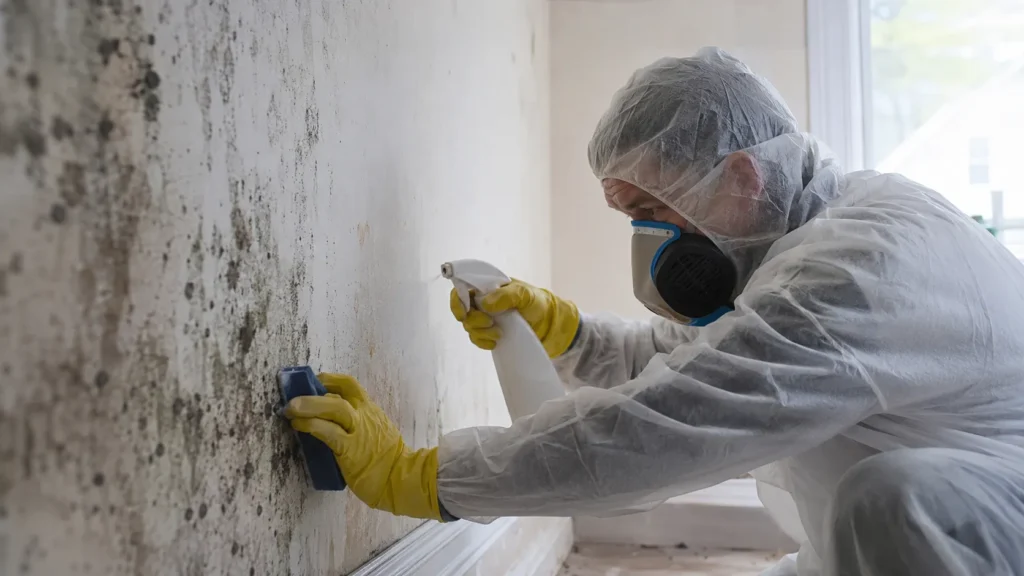
- Step 2: Antimicrobial Wet-Wiping. We perform a meticulous wipe-down using EPA-approved antimicrobial agents. These professional-grade solutions are designed to kill fungal structures on contact while preventing future regrowth.
- Step 3: Final HEPA Vacuuming. Once the surfaces are dry, we perform a second round of HEPA vacuuming mold removal. This catches any microscopic particles that were dislodged or “floated” during the wet-wiping phase.
Safety Protocols and PPE
We never perform remediation in an open environment. All vacuuming occurs within a high-density containment system. This barrier keeps your living spaces safe. Our technicians wear full PPE, including N95 or P100 respirators and protective Tyvek suits. This isn’t just for our safety; it prevents us from carrying spores out of the work zone on our clothing. After the job, all vacuum bags and filters are handled as hazardous waste and disposed of according to strict environmental regulations.
Addressing Porous vs. Non-Porous Materials
Not every material can be cleaned. Porous items like drywall or insulation often require interior demolition because the mould roots grow too deep to reach. However, semi-porous materials like structural wood can often be saved. During HEPA vacuuming mold removal in an attic, we also run negative air machines. These units create a pressure vacuum that pulls air through a HEPA filter, ensuring that any stray spores are trapped before they can enter your HVAC system. If you’re worried about the structural integrity of your home, contact our team for a professional assessment to see which materials can be salvaged.
Why Professional Remediation in Toronto is the Safest Bet
Temptation often leads homeowners to local tool rental shops. While renting a vacuum might seem cost-effective, it carries a significant risk of cross-contamination. Rental equipment is used on various hazardous sites across the GTA. If it wasn’t meticulously decontaminated between jobs, you could be bringing someone else’s toxic spores into your home. Professional HEPA vacuuming mold removal ensures that every piece of equipment is industrial-grade and strictly maintained to prevent internal leaks.
Toronto’s climate presents unique challenges. High humidity and aging infrastructure often lead to persistent basement dampness. Simply vacuuming visible growth isn’t enough; we integrate industrial drying and negative air pressure to stabilize the environment. This multi-pronged approach ensures that once the mould is removed, it doesn’t have the moisture it needs to return. We finish every project with lab-grade air quality testing to provide you with the mathematical proof that your home is safe for your children and pets.
Beyond the Vacuum: Comprehensive Containment
Safety requires more than just a good machine. We use 6-mil poly sheeting to create a physical isolation barrier around the work zone. This prevents microscopic debris from drifting into adjacent rooms while we work. Air scrubbers run continuously, cleaning the air while we perform the “HEPA sandwich” technique on surfaces. This prevents “ghosting,” where spores settle on walls or furniture outside the primary contaminated area. Our goal is to leave your home cleaner than we found it.
Choosing a Certified Specialist in the GTA
When selecting a remediator, verify their IICRC certification. This ensures they follow the ANSI/IICRC S520-2024 standard of care. Because water damage often happens at the worst possible times, we maintain 24/7 emergency availability throughout the Greater Toronto Area. We also offer a free video-call inspection to help you assess the situation immediately from your smartphone. Don’t wait for a small leak to become a health crisis. Contact Ultimate Mold Crew for a professional mould assessment today to restore your peace of mind.
Restore Safety to Your Toronto Home Today
Choosing the right method for fungal abatement determines whether your home becomes a sanctuary or a health risk. We’ve seen how standard vacuums act as spore-spreaders, while industrial, sealed systems trap even the most penetrating particles. By utilizing the professional “HEPA sandwich” technique, you ensure that stubborn spores are eradicated from your living space rather than simply redistributed. Professional HEPA vacuuming mold removal is the only reliable way to meet IICRC standards and pass final clearance testing.
As 5-Star Rated GTA Air Quality Specialists, our team provides the meticulous care your property deserves. We are IICRC Certified Master Remediators and operate as Toronto’s 24/7 Emergency Mould Response Team. You don’t have to navigate this stressful situation alone. We are here to provide the technical expertise and urgent reassurance needed to protect your family and restore your peace of mind.
Book Your Free Video-Call Mould Inspection with Ultimate Mold Crew to get an expert assessment from the comfort of your home. Your journey back to a clean, breathable environment is just a conversation away.
Frequently Asked Questions
Can I use a Shop-Vac with a HEPA filter for mould removal?
No, you should not use a standard Shop-Vac for mould remediation even if you install a HEPA-rated filter. These machines are not engineered as sealed systems. Air often bypasses the filter through gaps in the plastic housing or around the motor gaskets. This allows microscopic spores to escape back into your home’s air supply, which defeats the purpose of the cleaning. You need a machine that has been DOP tested to ensure zero leakage.
How much does a professional HEPA vacuum for mould remediation cost?
Industrial-grade HEPA vacuums are a significant investment, often costing between C$1,000 and C$3,000 for a certified unit. For those considering temporary solutions, rental costs in the Greater Toronto Area typically range from approximately C$80.00 per day for a 10-gallon unit to C$125.00 per day for a 45-gallon model. These prices reflect the specialized engineering and testing required to meet the strict 99.97% filtration benchmark necessary for hazardous material handling.
What is the difference between a HEPA-filter vacuum and a certified HEPA vacuum?
The main difference lies in the machine’s airtight construction. A vacuum with a HEPA filter simply uses a specific filter material, but air can still leak through unsealed joints in the vacuum’s body. A certified HEPA vacuum is a fully sealed system where 100% of the intake air is forced through the filter. This ensures the machine meets the 0.3-micron efficiency standard required for safe HEPA vacuuming mold removal without exhausting spores back into the room.
Is it safe to stay in the house while HEPA vacuuming for mould is being done?
It is generally safe to remain in your home, provided that the work area is properly isolated. Professionals use 6-mil poly sheeting and negative air pressure to ensure that no spores escape the containment zone during the process. However, you must stay away from the immediate work area while HEPA vacuuming mold removal is in progress. This prevents accidental exposure to dislodged particles and ensures the containment seal remains undisturbed.
How do I clean my HEPA vacuum after using it for mould?
Cleaning a vacuum used for mould requires strict safety protocols and personal protective equipment. You must wear a respirator and gloves while carefully removing the collection bag and sealing it in a heavy-duty poly bag for hazardous waste disposal. The interior and exterior of the vacuum should be wet-wiped with an antimicrobial agent to neutralize any remaining particles. Because the HEPA filter itself becomes a reservoir for spores, it should be replaced after any major remediation project.
Does HEPA vacuuming kill mould spores or just remove them?
HEPA vacuuming is a mechanical removal process, not a chemical treatment. It does not kill the spores; instead, it physically extracts them from surfaces and traps them within a sealed filtration system. This is a critical distinction because even dead mould spores can cause allergic reactions or respiratory issues. By removing the spores entirely from the environment, you eliminate the risk of toxic exposure that persists when mould is simply killed and left in place.
