
Updated on 22-Sep-2026
Moisture does not need to drip down a wall or leave a puddle before it can create a mold problem.
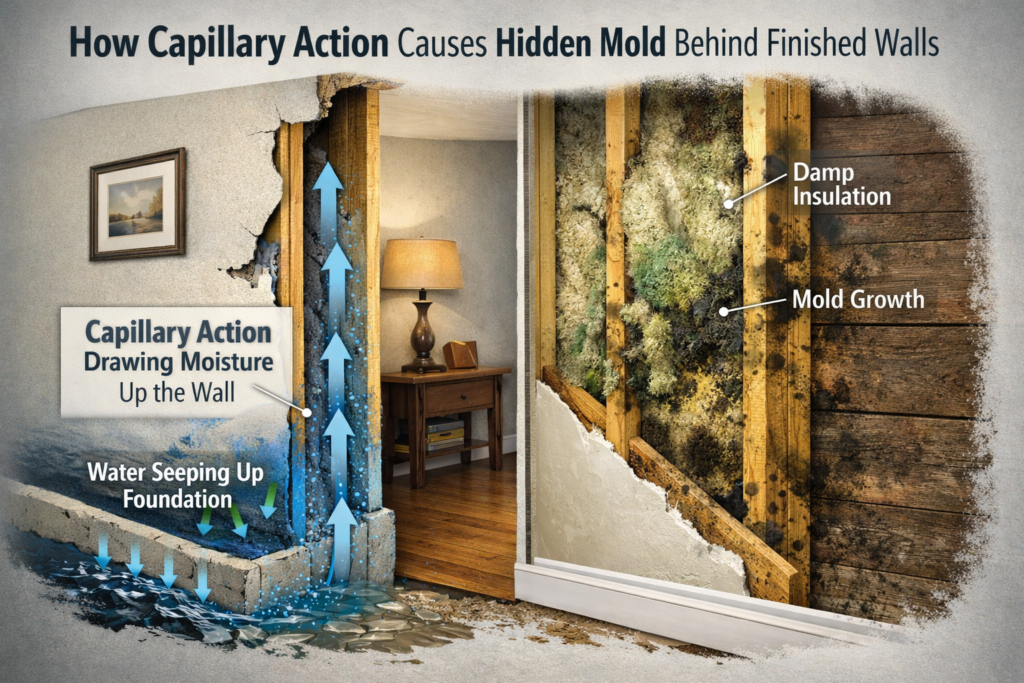
Porous building materials such as concrete, masonry and wood can move liquid water through small interconnected pores. This process is called capillary action..
In a basement or finished wall assembly, capillary moisture can move from damp soil or a wet foundation into adjoining materials. Drywall paper, wood framing and other moisture-sensitive materials can then remain damp enough for hidden mold to develop.
Natural Resources Canada identifies capillary action as one of several ways moisture moves through a building. Groundwater can migrate through inadequately protected foundation walls or floors even when there is no obvious flowing leak.
This helps explain some cases where homeowners find mold behind drywall while the painted surface still appears relatively normal.
However, capillary action is only one possible cause of hidden wall moisture. Plumbing leaks, rain penetration, condensation, air leakage and vapour diffusion can create similar symptoms.
The key is to identify how the water is entering and moving through the wall assembly before repairing the mold damage.
Table of Contents
What Is Capillary Action in a Wall?
Capillary action is the movement of liquid water through small pores or narrow spaces in a material.
A simple example is a paper towel drawing water upward from a glass.
In a building, similar movement can occur through porous materials such as:
- concrete
- concrete block
- brick
- mortar
- wood
- some gypsum-based materials
The U.S. Department of Energy describes capillary transport as moisture moving through interconnected pores or between adjoining water-attracting materials because of surface tension.
Water can move upward or sideways through these pore networks.
That does not mean every wet wall is experiencing capillary action.
Water may also enter or move through a wall by leakage, rain penetration, air movement, vapour diffusion or condensation.
Capillary Action vs Condensation vs Water Leakage
These moisture problems can produce similar visible symptoms but require different repairs.
| Moisture problem | How moisture moves | Common example |
|---|---|---|
| Capillary action | Liquid water moves through porous materials | Ground moisture wicking into concrete |
| Water intrusion | Liquid water enters through openings | Foundation crack or window leak |
| Plumbing leak | Water escapes from plumbing | Slow pipe leak inside a wall |
| Condensation | Water vapour becomes liquid | Humid air contacting a cold basement wall |
| Vapour diffusion | Water vapour moves through materials | Ground moisture evaporating through concrete |
| Air leakage | Humid air enters a cavity through gaps | Indoor air leaking into a cold exterior wall |
A moisture inspection should determine which process is occurring before repairs begin.
Painting a condensation problem, waterproofing a plumbing leak or installing a dehumidifier for groundwater wicking can leave the actual source unresolved.
Where Capillary Moisture Commonly Starts
Capillary moisture is most relevant where porous building materials contact damp soil, concrete or another wet material.
Common locations include:
Basement Foundation Walls
Soil around below-grade foundation walls remains in regular contact with moisture.
If exterior drainage, dampproofing or waterproofing does not adequately manage that water, masonry or concrete may absorb moisture.
Natural Resources Canada specifically notes that groundwater can migrate through inadequately waterproofed foundations by capillary action.
Concrete Basement Floors
Ground moisture can move upward through a concrete slab when an effective capillary break and vapour-control layer are absent or compromised.
Older CMHC building-science guidance describes concrete slabs becoming moisture-loaded from below by capillary action without necessarily showing obvious surface water.
Foundation-to-Wall Connections
Wood framing or other moisture-sensitive materials placed directly against damp concrete can receive moisture from the foundation.
Modern building practices use capillary breaks between moisture-bearing masonry and moisture-sensitive assemblies for this reason.
Masonry Walls
Brick, mortar and concrete block contain pore networks capable of absorbing and transporting liquid water.
Moisture may move upward from the base or laterally from a wet exterior surface.
Does Capillary Action Mean You Have “Rising Damp”?
Not necessarily.
Rising damp generally refers to ground moisture moving upward through masonry by capillary action.
True rising damp exists, but the term is frequently applied to moisture problems that have other causes.
A damp lower wall can also result from:
- foundation seepage
- plumbing leaks
- exterior grading problems
- rain penetration
- condensation
- high indoor humidity
- snowmelt
- blocked drainage systems
Organizations such as RICS and the Society for the Protection of Ancient Buildings caution that rising damp is often misdiagnosed.
A visible damp line should therefore be treated as evidence of a moisture problem rather than proof of a specific mechanism.
What Signs Suggest Capillary Moisture?
Possible clues include:
- dampness concentrated near the bottom of a wall
- moisture readings that are higher near the floor
- recurring peeling or blistering paint
- damaged baseboards
- deteriorating plaster
- persistent musty odours
- white crystalline deposits on concrete or masonry
- damp flooring along foundation walls
- mold returning after drywall replacement
White crystalline material on masonry is often efflorescence.
Efflorescence occurs when water moves dissolved salts through masonry. The water evaporates and leaves the salts behind.
It can provide useful evidence that moisture has travelled through the material, although it does not prove by itself that capillary action is the only moisture mechanism involved.
What Capillary Action Is in Building Materials
Capillary action is the ability of a material to draw moisture through its internal pore structure.
In buildings, this means water can travel:
- Upward
- Sideways
- Across assemblies
against gravity and without pressure.
Materials commonly affected include:
These materials are hygroscopic, meaning they naturally absorb and retain moisture.
Why Finished Basement Walls Can Hide the Problem
A bare concrete foundation can release moisture toward the interior where it may be noticed and allowed to dry.
A finished basement changes the assembly.
A typical finished wall may contain:
concrete foundation → insulation → wood framing → drywall → paint
If moisture reaches moisture-sensitive materials and drying is restricted, the homeowner may see very little from inside the room.
Mold may begin on:
- the paper face on the back of drywall
- wooden studs
- bottom plates
- dust and debris inside the cavity
- paper-faced insulation products
- baseboards
How Can You Tell What Is Causing Mold Behind a Wall?
A moisture meter can identify an unusual moisture pattern, but the reading alone does not explain the source.
The location and shape of the moisture pattern provide useful clues.
| Pattern | Possible cause |
|---|---|
| Moisture strongest at bottom of foundation wall | Ground moisture, seepage or capillary transport |
| Localized wet area near pipe | Plumbing leak |
| Wetness below a window | Rain penetration or flashing problem |
| Exterior wall becomes damp during humid weather | Condensation may be involved |
| Moisture follows foundation cracks | Water intrusion |
| Dampness appears after heavy rain | Exterior drainage or foundation issue |
| White deposits on concrete | Moisture moving through masonry |
| Mold behind recently installed basement drywall | Trapped foundation moisture, condensation or pre-existing dampness |
Can Mold Grow Behind a Wall Without a Visible Water Stain?
Yes.
The room-facing surface of drywall can remain relatively dry while moisture exists deeper in the assembly.
Several conditions can create this pattern:
- moisture entering from the foundation side
- wet insulation touching drywall
- condensation inside the cavity
- slow plumbing seepage
- moisture moving through masonry
- limited airflow behind finishes
Drywall is particularly vulnerable because its paper facing provides an organic food source for mold when it remains damp.
The EPA recommends drying wet building materials within approximately 24 to 48 hours because prolonged moisture increases the chance of mold growth.
A wall does not need to be visibly dripping before hidden growth becomes possible.
Where We See Capillary and Foundation Moisture in Toronto Homes
In Toronto, hidden basement mold often appears where a finished interior wall has been built in front of a foundation that is allowing moisture into the assembly.
We pay particular attention to:
- older poured-concrete foundations
- concrete-block foundation walls
- finished basements
- cold rooms
- slab edges
- foundation-to-floor joints
- below-grade exterior walls
- basement renovations installed against previously damp concrete
Seasonal conditions matter.
Heavy rain, snowmelt and saturated soil can increase foundation moisture. Summer humidity can create a separate condensation problem when warm air reaches cold basement surfaces.
That is why two Toronto houses with mold behind basement wall may require completely different corrections.
Why Drying or Repainting the Surface May Not Solve the Problem
Running a dehumidifier can lower indoor relative humidity.
It cannot stop groundwater from entering porous foundation materials.
Likewise:
- repainting does not repair exterior drainage
- replacing drywall does not stop foundation moisture
- cleaning visible mold does not dry wet insulation
- waterproof paint does not diagnose the source
- running fans does not repair a plumbing leak
the moisture source has to be corrected.
If wet conditions continue behind the wall, replacing the visible finish may simply conceal the next cycle of damage.
This explains why mold can return even after walls appear dry.
Why Capillary Action Is Missed During Inspections
Standard inspections focus on visible damage.
Capillary moisture:
- Does not drip
- Does not pool
- Does not always stain
Without moisture mapping and building science evaluation, this type of problem is easily overlooked.
How Is Capillary Moisture Behind Walls Corrected?
There is no single repair for every capillary-moisture problem.
The correct solution depends on where the water originates.
Exterior Groundwater
Possible corrections may include:
- improving grading
- extending downspouts
- repairing foundation drainage
- exterior waterproofing or dampproofing
- correcting foundation defects
Moisture Rising Through a Slab
The building assembly may require assessment of:
- under-slab moisture
- drainage
- vapour control
- capillary breaks
- flooring systems
Wet Foundation Against Finished Wall
The wall may need to be opened so affected drywall, insulation and framing can be evaluated.
The foundation moisture issue should be corrected before the wall is rebuilt.
Condensation Inside the Wall
The solution may involve:
- reducing indoor humidity
- controlling air leakage
- improving insulation
- adjusting vapour control
- redesigning the wall assembly
The important sequence is:
- identify moisture source → determine moisture pathway → correct the building problem → remove contaminated materials → dry the assembly → rebuild
How Ultimate Mold Crew Identifies Capillary-Driven Mold
Ultimate Mold Crew investigates mold problems by tracing moisture movement, not just visible damage.
This includes:
- Moisture profiling across wall assemblies
- Identifying hygroscopic material behavior
- Locating indirect moisture sources
- Assessing temperature and humidity patterns
This approach uncovers mold that surface inspections miss.
