
Updated on 13-Jul-2026
Mold reports often contain technical language that is difficult to interpret without context.
A laboratory may describe fungal spores by genus. An inspector may record moisture conditions, air leakage, or suspected microbial growth. A mold remediation contractor may refer to containment, negative air pressure, HEPA filtration, source removal, or post-remediation verification.
These terms do not all describe the same part of a mold problem.
This glossary explains the language used during:
- Mold inspection and assessment
- Moisture investigation
- Air and surface sampling
- Laboratory analysis
- Mold containment and removal
- Water-damage restoration
- Structural drying
- Post-remediation verification
Each definition includes practical context so property owners can understand why the term may appear in an inspection report, remediation plan, contractor estimate, insurance file, or laboratory result.
Canadian publications generally use the spelling mould, while mold is common in the United States and in online searches. Both words refer to the same type of fungal growth.
Visible mold should not be judged only by colour or species. The more useful questions are:
- What moisture source allowed it to grow?
- Which materials are affected?
- How far has the moisture travelled?
- Can the material be cleaned, or must it be removed?
- What evidence will confirm that the area is dry and the remediation is complete?
Indoor mold growth is associated with damp conditions, and no health-based numerical exposure limit exists for mold in Canadian homes. The extent of growth, duration of exposure, building conditions, and individual susceptibility all affect the level of concern. A common health effect of mold in indoor environments is hay fever-like symptoms.
In addition to this layman mold glossary, professional mold inspection and mold testing is the best way to determine exactly what kind of mold is growing in your home. You can learn more about our Toronto mold removal .
Below is a non-exhaustive list of fungi and mold terms which a layman must know about – NO BS/TECHNICAL STUFF.
Table of Contents
A
Absolute Humidity
Absolute humidity is the amount of water vapour contained in a given volume of air. It is commonly expressed as grams of water per cubic metre of air.
Absolute humidity differs from relative humidity. Absolute humidity describes the actual quantity of water vapour. Relative humidity describes how close the air is to saturation at its current temperature.
Warm air can contain more water vapour than cold air. As air cools, its relative humidity can rise even when the absolute amount of water vapour remains unchanged. If a surface becomes cold enough, condensation can form.
Why it matters: Absolute humidity can help building professionals understand moisture movement, ventilation, and mechanical-system performance. For ordinary mold prevention inside a home, relative humidity and surface temperature are usually more practical measurements.
Related terms: relative humidity, dew point, condensation, vapour pressure
Sources:
- Canadian Conservation Institute: Climate Guidelines Glossary
- Health Canada: Guide to Addressing Moisture and Mould Indoors
Acremonium
Acremonium is a genus of fungi found in soil, plant material, and indoor and outdoor environments. It may appear in moisture-damaged buildings, but its presence cannot be confirmed from colour or appearance alone.
A laboratory may identify Acremonium in an air, surface, or bulk sample. Finding the genus does not by itself prove that occupants face a specific health risk or that the entire building is contaminated.
The result must be interpreted with:
- The sampling location
- Visible growth
- Moisture conditions
- Comparison samples
- Building history
- The inspection findings
- The collection and laboratory methods
Why it matters: Acremonium may appear in laboratory reports after water intrusion. The finding is most useful when it supports physical evidence of indoor fungal growth or moisture damage.
Related terms: genus, fungal spores, air sample, laboratory analysis
Sources:
- NIOSH Evaluation of Mold Contamination in a Water-Damaged Building
- NIOSH Report Discussing Acremonium and Other Indoor Fungi
Air Changes per Hour
Air changes per hour, often shortened to ACH, describes how many times the volume of air in a room or enclosed space is replaced or processed during one hour.
The basic calculation compares hourly airflow with the volume of the space.
For example, a room with six air changes per hour receives or processes an airflow volume equal to six times the room’s volume each hour. This does not mean every particle is removed or that all room air is replaced evenly. Air can follow short paths, bypass corners, or move differently around walls and furnishings.
In a mold-remediation work area, ACH may be used to plan air filtration and pressure control. The appropriate rate depends on the room, equipment, containment design, leakage, and project conditions.
Why it matters: ACH can appear in remediation plans, air-filtration calculations, ventilation assessments, and drying strategies. A higher number alone does not prove that containment is working correctly.
Related terms: airflow, air exchange rate, negative air pressure, air scrubber
Sources:
Air Leakage
Air leakage is the uncontrolled movement of air through cracks, gaps, joints, and openings in a building.
Common leakage paths include:
- Window and door frames
- Attic hatches
- Plumbing and wiring penetrations
- Rim joists
- Foundation joints
- Recessed lights
- Exhaust ducts
- Gaps around baseboards
- Openings between wall and ceiling assemblies
Air leakage can carry heat and moisture into colder parts of a building. During winter, warm indoor air may leak into an attic or exterior wall and cool below its dew point. The resulting condensation can wet insulation, roof sheathing, drywall, or framing.
Air leakage can also affect mold containment. Gaps in barriers or unsealed penetrations may allow air and particles to move outside the work area.
Why it matters: Air leakage may contribute to hidden condensation, attic mold, cold-wall moisture, uneven drying, and loss of pressure inside a remediation containment.
Related terms: air infiltration, condensation, thermal bridge, building envelope
Sources:
- US EPA: Introduction to Indoor Air Quality
- Health Canada: Guide to Addressing Moisture and Mould Indoors
Air Sample
An air sample collects airborne particles from a measured volume of air for laboratory examination.
Mold investigations often use a spore-trap cassette. A calibrated pump draws air through the cassette, and airborne particles adhere to a collection surface. A laboratory examines the deposit and reports fungal structures detected in the sample.
An air sample represents conditions at a particular location and time. Results can change with:
- Outdoor spore levels
- Weather
- Open windows
- HVAC operation
- Cleaning
- Foot traffic
- Air movement
- Sampling height
- Recent disturbance
- The duration and flow rate of collection
Air sampling does not locate moisture, prove that a building is safe, or rule out concealed growth. A low result in one room does not confirm that a closed wall cavity is free from mold.
Visible mold usually does not need to be sampled before removal. Inspection and moisture-source identification often provide more useful information for planning remediation.
Why it matters: Air sampling can answer a defined investigation question, but it should support an inspection rather than replace one.
Related terms: spore trap, indoor-outdoor comparison, total spore count, sampling plan
Sources:
Air Scrubber
An air scrubber is a portable air-filtration machine that draws air through one or more filters and returns filtered air to the space.
In mold remediation, the final filter is commonly a high-efficiency particulate air filter. Pre-filters may capture larger dust and debris before the air reaches the HEPA filter.
An air scrubber can be used in two main ways.
Recirculation mode: The machine filters air within the same room or containment.
Negative-air mode: Filtered exhaust air is ducted outside the containment, helping create lower air pressure inside the work area.
An air scrubber does not remove mold growing on drywall, framing, insulation, flooring, or contents. It supports particle control while contaminated materials are cleaned or removed.
Its performance depends on:
- Filter condition
- Airflow
- Equipment size
- Room volume
- Placement
- Barrier integrity
- Ducting
- Maintenance
- Operating time
Why it matters: Air scrubbers help reduce airborne particles during remediation, but they do not replace source removal, surface cleaning, or moisture correction.
Related terms: HEPA filter, negative-air machine, containment, air changes per hour
Sources:
- US EPA: Mold Remediation in Schools and Commercial Buildings
- ANSI/IICRC S520 Standard for Professional Mold Remediation
Allergen
An allergen is a substance that can trigger an allergic immune response in a person who is sensitive to it.
Mold spores, fungal fragments, and other fungal components can act as allergens. Reactions vary between individuals. A person may be exposed without experiencing symptoms, while a sensitized person may develop symptoms such as:
- Sneezing
- Nasal congestion
- Eye irritation
- Coughing
- Wheezing
- Worsening asthma symptoms
An allergen is not the same as a toxin or infectious organism. These terms describe different biological processes.
Killing mold does not necessarily remove its allergenic material. Dead spores and fungal fragments may still trigger reactions in some people, which is one reason physical removal and cleaning remain important.
Why it matters: A product that claims to kill mold does not automatically remove spores, fragments, dust, or contaminated porous material from the building.
Related terms: sensitization, irritant, spore, fungal fragment
Sources:
- Health Canada: Guide to Addressing Moisture and Mould Indoors
- US EPA: A Brief Guide to Mold, Moisture and Your Home
Alternaria
Alternaria is a widespread genus of fungi commonly associated with soil, plants, decaying vegetation, and outdoor air. Its spores can enter buildings through doors, windows, ventilation systems, clothing, and other normal pathways.
Alternaria may also be detected indoors, especially where damp materials or accumulated organic matter support fungal growth.
A laboratory result identifying Alternaria does not prove that the source is indoors. Interpretation should consider:
- Outdoor conditions
- Indoor and outdoor sample results
- Visible growth
- Moisture damage
- Sampling location
- HVAC operation
- Seasonal conditions
Some Alternaria species are recognized allergens. Exposure may contribute to allergic symptoms or asthma problems in susceptible individuals, but a reported spore count cannot diagnose the cause of a person’s symptoms.
Why it matters: Alternaria in an air sample may reflect ordinary outdoor entry, indoor growth, or both. The inspection findings determine whether the result has practical significance.
Related terms: outdoor control sample, fungal genus, allergen, spore count
Sources:
- CDC: Mold and Common Indoor Mold Types
- NIOSH Research on Alternaria Exposure and Damp Indoor Environments
Antimicrobial
An antimicrobial is a substance or treatment intended to kill, reduce, or inhibit microorganisms. Depending on the product and its approved use, the microorganisms may include bacteria, fungi, viruses, or other microbes.
The term does not describe one specific chemical. It covers many products with different active ingredients, application methods, contact times, safety requirements, and approved uses.
During mold remediation, an antimicrobial may be used on certain cleaned materials when the product label permits that use. It does not replace the physical removal of mold growth, dust, fungal fragments, or contaminated porous materials.
A complete mold-remediation process still requires the crew to:
- Identify and correct the moisture source
- Define the affected area
- Establish containment where needed
- Remove materials that cannot be adequately cleaned
- Clean salvageable surfaces
- Control airborne particles
- Dry the remaining materials
- Verify that the agreed completion conditions have been met
Applying a liquid product to visible mold without correcting the damp condition can leave the cause of growth unresolved. The affected material may remain wet, and fungal material can remain on the surface even after organisms are no longer viable.
The distinction between chemical treatment and complete removal is explored further in the comparison of natural mold-cleaning methods and chemical treatments.
Why it matters: The word antimicrobial may appear in a remediation estimate or product description. Property owners should ask what product will be used, where it will be applied, why it is needed, and whether physical cleaning or material removal is also included.
Related terms: biocide, fungicide, source removal, cleaning agent
Sources:
- US EPA: Mold Remediation in Schools and Commercial Buildings
- ANSI/IICRC S520 Standard for Professional Mold Remediation
Antimicrobial Coating
An antimicrobial coating is a coating formulated to resist, inhibit, or reduce microbial growth on a treated surface when used according to its label.
These products may be applied to selected building materials after remediation, but they should not be confused with mold removal.
A coating should not be used to cover:
- Active mold growth
- Wet building materials
- Dust or loose debris
- Deteriorated drywall
- Contaminated insulation
- Decayed wood
- An unresolved leak or condensation problem
The surface must first be assessed, cleaned, and dried. Materials that cannot be restored should be removed rather than coated.
Some coatings are marketed as mold-resistant paints or encapsulants. Product performance varies by formulation, substrate preparation, moisture exposure, film thickness, and application conditions. The product label determines where and how a coating may be used.
A coating can fail when moisture continues to enter from behind the treated surface. This can occur on foundation walls, exterior wall cavities, roof sheathing, cold-room walls, or other assemblies where the water source has not been corrected.
Why it matters: An antimicrobial coating may support prevention on a suitable, clean, dry surface. It cannot make contaminated porous material clean or stop mold caused by ongoing moisture.
Related terms: encapsulation, surface preparation, fungicide, moisture control
Sources:
- US EPA: Mold Remediation in Schools and Commercial Buildings
- ANSI/IICRC S520 Standard for Professional Mold Remediation
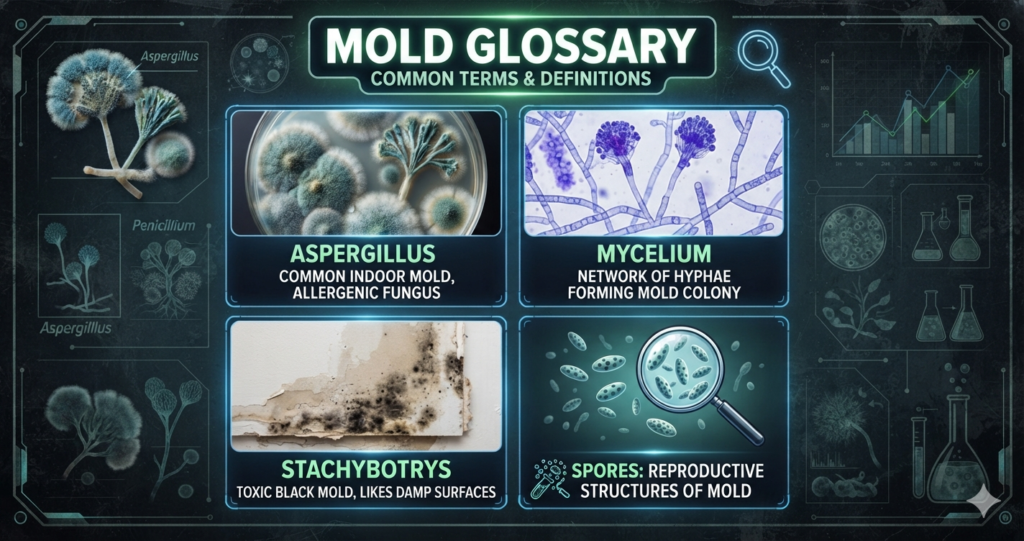
Aspergillus
Aspergillus is a large genus of fungi found in soil, dust, decaying vegetation, outdoor air, and indoor environments. It is one of the fungal groups commonly reported in indoor mold samples.
Different Aspergillus species have different environmental preferences and biological characteristics. A laboratory may identify the sample only to the genus level because many species cannot be distinguished reliably through routine microscopic spore-trap analysis.
Aspergillus spores may enter a building from outdoors through:
- Open doors and windows
- Ventilation systems
- Air leakage
- Clothing and footwear
- Normal occupant movement
The same genus may also grow indoors where moisture affects drywall, settled dust, insulation, wood products, ceiling tiles, stored contents, or other suitable materials.
Finding Aspergillus in one air sample does not automatically prove that a colony is growing inside the building. The result should be interpreted with the inspection findings, moisture conditions, sample location, outdoor comparison, and collection method.
A report may become more significant when:
- Indoor concentrations are notably elevated compared with outdoors
- The genus appears repeatedly in affected rooms
- Visible or concealed growth is found
- Water-damaged materials are present
- The distribution is inconsistent with ordinary outdoor entry
- Surface or bulk samples support an indoor source
Some Aspergillus species can trigger allergic responses. Certain species can also cause infection in people with severely weakened immune systems. A laboratory result alone cannot diagnose illness or predict an individual health outcome.
Colour is not a reliable identification method. Green, yellow, brown, white, or dark growth may involve Aspergillus or another fungal genus. The limitations of visual identification are explained in the guide to different types of mold found in homes.
Why it matters: Aspergillus often appears in laboratory reports, but the name should not be interpreted without the building history, moisture evidence, sample type, and distribution of results.
Related terms: genus, fungal spores, spore-trap analysis, indoor-outdoor comparison
Sources:
Assessment
A mold assessment is the process of collecting and evaluating information about suspected mold growth, moisture conditions, affected materials, and the building environment.
An assessment is broader than taking an air or surface sample. It may include:
- Interviewing the owner or occupant
- Reviewing the history of leaks, flooding, or condensation
- Inspecting visible surfaces
- Looking for water staining and material damage
- Measuring moisture
- Checking relative humidity and temperature
- Tracing the likely water pathway
- Examining adjacent rooms
- Reviewing HVAC or ventilation conditions
- Considering concealed cavities
- Determining whether sampling would answer a useful question
- Defining the likely remediation scope
The purpose is to understand the problem well enough to make an informed decision.
A limited assessment may focus on one room or one reported event. A more extensive assessment may cover multiple floors, shared systems, or a commercial building.
Assessment and remediation are related but separate activities.
- Assessment identifies and evaluates the condition.
- Remediation controls and removes the contamination.
This distinction matters when a property owner is comparing mold assessment with mold remediation or deciding whether testing is needed before work begins.
Visible mold can often be assessed without identifying the exact species. Moisture-source correction and affected-material decisions usually have greater practical value than naming every organism present.
Why it matters: The assessment determines what is known, what remains uncertain, and what work may be required. A weak assessment can lead to unnecessary sampling, incomplete removal, missed moisture sources, or an inaccurate estimate.
Related terms: inspection, scope of work, moisture survey, remediation protocol
Sources:
Baseline Condition
A baseline condition is the documented state of a property, room, material, or indoor environment before an event or before work begins.
The baseline may include:
- Photographs
- Moisture readings
- Relative humidity
- Temperature
- Visible staining
- Existing material damage
- Odours
- Previous leak locations
- Earlier inspection results
- Air or surface sample results
- Notes about occupant activities
- The operating condition of HVAC equipment
A baseline does not always mean the building is free from mold. It describes the condition that existed at the chosen starting point.
For example, photographs taken before a plumbing failure may show that a basement wall had no visible staining. Moisture readings collected before remediation may show which materials were wet. An outdoor air sample may provide a comparison point for indoor sampling conducted at the same time.
The value of baseline information depends on how and when it was collected. A measurement taken after equipment has already been running may not represent the original condition.
Baseline records can also help during insurance, tenancy, construction, and post-remediation disputes. A clear record makes it easier to separate pre-existing damage from conditions associated with a newer event.
Property owners dealing with a claim can strengthen the record by following a consistent process for documenting mold and moisture damage.
Why it matters: A baseline gives later findings a point of comparison. Without one, it may be difficult to show whether moisture levels, visible conditions, or airborne particles changed during the project.
Related terms: documentation, reference sample, moisture map, post-remediation verification
Sources:
Biocide
A biocide is a substance intended to control, inhibit, or destroy living organisms. The organisms targeted depend on the product and may include fungi, bacteria, algae, viruses, insects, or other pests.
In mold-related work, the word is sometimes used broadly for products marketed to kill mold. That description can create a false impression that killing organisms is the same as completing remediation.
Mold remediation focuses on removing contamination and correcting the moisture condition that allowed growth. A biocide cannot by itself:
- Remove damaged drywall or insulation
- Extract fungal fragments from a porous surface
- Correct a leaking pipe
- Stop foundation seepage
- Dry a wall cavity
- Restore decayed wood
- Prevent recurrence where moisture remains
- Confirm that a project has met completion criteria
Dead fungal material can remain allergenic or irritating. Physical cleaning and removal may still be needed even when a product has reduced organism viability.
Routine whole-room fogging is also different from targeted application to a specific material. A fog or mist may not reach mold inside wall cavities or beneath flooring, and it may distribute chemicals into areas where they were not needed.
Any product should be used only on approved surfaces, at the labelled concentration, with the required contact time, ventilation, and personal protective equipment.
Why it matters: The presence of a “mold-killing” product in an estimate does not prove that the project includes adequate source removal, containment, drying, or moisture correction.
Related terms: antimicrobial, fungicide, viability, source removal
Sources:
- US EPA: Mold Remediation in Schools and Commercial Buildings
- US EPA: A Brief Guide to Mold, Moisture and Your Home
Black Mold
Black mold is an informal description for mold that appears black or very dark. It is not a scientific identification.
Many fungal genera can produce dark-coloured growth. The appearance may also change with:
- The underlying material
- Moisture level
- Colony age
- Lighting
- Surface dust
- Pigmentation
- Other organisms growing nearby
The term is often used specifically for Stachybotrys chartarum, but dark growth cannot be identified as Stachybotrys by colour alone.
The same limitation applies in reverse. Stachybotrys chartarum does not always appear as a uniform jet-black patch under every condition.
A photograph or visual inspection cannot reliably determine:
- The genus or species
- Whether mycotoxins are present
- Whether the mold is viable
- The exact age of the growth
- The level of health risk
- Whether the contamination is limited to the visible surface
The colour should not determine whether the moisture source is corrected or whether affected materials are cleaned or removed. Visible mold of any colour indicates that moisture has supported fungal growth.
The practical differences between colour, species, and remediation requirements are examined in black mold versus other indoor mold.
Why it matters: Calling growth “black mold” can create fear without providing a reliable identification. The remediation decision should be based on moisture, affected materials, extent, location, and building use rather than colour alone.
Related terms: Stachybotrys chartarum, toxigenic mold, mycotoxin, visual identification
Sources:
B
Baseline Condition
A baseline condition is the documented state of a room, building material, or indoor environment before an event or before remediation begins.
The baseline may include:
- Wide and close-up photographs
- Moisture readings
- Relative humidity and temperature
- Visible staining or deterioration
- Existing odours
- Previous leak locations
- Earlier inspection findings
- Air or surface sample results
- Notes about ventilation and HVAC operation
- The condition of drywall, flooring, insulation, framing, and contents
A baseline does not mean the property is dry or free from mold. It records the condition at a defined starting point so later findings can be compared with it.
For example, photographs taken before a plumbing failure may show that a basement wall had no visible staining. Initial moisture readings may identify which materials became wet after the event. Photographs captured before demolition may show where water moved behind drywall and insulation.
Timing affects the value of the record. Measurements collected after dehumidifiers and air movers have operated for several days may not represent the conditions found when the loss was discovered.
Baseline documentation can also help distinguish:
- New damage from pre-existing deterioration
- Wet materials from unaffected materials
- Conditions before and after remediation
- Visible damage from concealed findings
- Work caused by a recent event from unrelated maintenance issues
Property owners dealing with water or mold damage should create a dated record before finishes are cleaned, removed, or rebuilt. The process for documenting mold damage for an insurance claim explains which photographs, moisture records, invoices, and timeline details may help preserve that evidence.
A baseline becomes even more useful when paired with post-remediation verification. The initial condition records where the project began. The final assessment records whether the agreed cleaning, removal, and moisture objectives were met.
Why it matters: A baseline gives later observations a point of comparison. Without it, owners, contractors, adjusters, and property managers may struggle to determine what changed during the loss or remediation project.
Related terms: documentation, moisture map, initial assessment, post-remediation verification
Sources:
Biocide
A biocide is a substance intended to destroy, inhibit, deter, or control living organisms. Depending on the product, the targeted organisms may include fungi, bacteria, viruses, algae, insects, or other biological agents.
In mold-related work, the term is often used for a chemical product intended to kill or suppress fungal growth.
Killing mold is not the same as completing mold remediation.
A biocide cannot by itself:
- Remove contaminated drywall or insulation
- Remove fungal fragments from a porous material
- Correct a plumbing leak
- Stop foundation seepage
- Dry a concealed wall cavity
- Restore decayed framing
- Remove settled dust and spores
- Prevent regrowth while moisture remains
Dead fungal spores and fragments can remain on a surface after treatment. Physical cleaning, HEPA vacuuming, controlled material removal, and moisture correction may still be required.
The limitations of chemical treatment are important when comparing natural mold removal methods with chemical treatments. The correct method depends on the material, extent of contamination, moisture source, occupancy, and project conditions.
A targeted application also differs from whole-room fogging.
Fogging may distribute a chemical through the air, but it does not prove that the product reached mold:
- Behind drywall
- Beneath flooring
- Inside insulation
- Under cabinetry
- Within a ceiling cavity
- On the back of a porous material
Chemical fogging also does not physically remove contaminated material. The distinction between treatment and removal is especially important where mold is growing behind drywall or inside another concealed assembly.
Any biocidal product should be used according to its label. The instructions govern approved surfaces, concentration, contact time, ventilation, personal protective equipment, storage, and disposal.
Why it matters: The presence of a mold-killing chemical in an estimate does not confirm that the project includes containment, source removal, detailed cleaning, drying, or correction of the moisture problem.
Related terms: antimicrobial, fungicide, source removal, viability
Sources:
- US EPA: Mold Remediation in Schools and Commercial Buildings
- National Toxicology Program: Biocides and Potential Respiratory Health Outcomes
Bioaerosol
A bioaerosol is an airborne particle or droplet that comes from a biological source.
Indoor bioaerosols may include:
- Fungal spores
- Fungal fragments
- Pollen
- Bacteria
- Viruses
- Skin particles
- Insect fragments
- Biological material attached to dust
Mold spores are one type of bioaerosol, but the two terms are not interchangeable.
Bioaerosol levels can change throughout the day. Movement inside a room, cleaning, demolition, outdoor air, HVAC operation, humidity, and ventilation can all affect what becomes airborne.
During mold remediation, disturbing contaminated drywall, insulation, flooring, or settled dust can release fungal particles into the air. Containment, HEPA filtration, controlled removal, and detailed cleaning are used to reduce movement beyond the work area.
A bioaerosol sample represents conditions during a limited collection period. It does not show every particle that was present earlier, and it does not prove that a concealed cavity is free from growth.
Readers interpreting airborne results should review how mold spore levels are assessed rather than treating one number as a universal safe or unsafe threshold.
Why it matters: The term may appear in indoor-air-quality reports, sampling plans, occupational assessments, and remediation protocols. It describes airborne biological material, not one specific mold species or exposure level.
Related terms: fungal spore, airborne particle, air sample, indoor air quality
Sources:
Biofilm
A biofilm is a structured community of microorganisms attached to a surface and surrounded by material produced by the organisms.
Biofilms commonly form in persistently wet environments, including:
- Drains
- Cooling systems
- Condensate pans
- Plumbing
- Water tanks
- Wet mechanical components
- Medical and industrial equipment
The term should not be used as a synonym for every patch of household mold.
Visible fungal growth on drywall may involve hyphae, spores, dust, and damaged material without fitting the more specific way that biofilm is used in microbiology.
In buildings, biofilm may be relevant where moisture remains present for long periods. Examples include slime inside a drain, microbial buildup in standing water, or growth inside a poorly maintained HVAC condensate system.
A surface coating or disinfectant may reduce some organisms without removing the attached material. Cleaning must address the physical buildup and the moisture condition supporting it.
Where mold or microbial growth involves ventilation equipment, the inspection should consider the full system rather than treating only a visible register. The guide to mold in HVAC systems and air ducts explains how condensate, dust, filters, insulation, and mechanical components can contribute to contamination.
Why it matters: Biofilm is a specific microbiological term. Using it accurately prevents ordinary mold growth from being described with language that implies a different type of microbial condition.
Related terms: microbial growth, extracellular material, HVAC contamination, surface cleaning
Sources:
Black Mold
Black mold is an informal description for mold that appears black, dark green, dark brown, or another very dark colour. It is not a scientific identification.
Many fungal genera can produce dark growth. Colour may also change because of:
- The building material
- Available moisture
- Lighting
- Colony age
- Surface dust
- Pigmentation
- Other organisms growing nearby
The term is often used for Stachybotrys chartarum. Dark growth cannot be identified as Stachybotrys by appearance alone.
The reverse is also true. Stachybotrys chartarum does not always appear as one uniform jet-black patch under every condition.
A photograph or visual inspection cannot reliably determine:
- The fungal genus or species
- Whether mycotoxins are present
- Whether the spores are viable
- The exact age of the growth
- The source of the moisture
- The level of health risk
- Whether contamination extends behind the visible surface
Mold colour should not determine whether a material requires cleaning or removal. Visible growth of any colour shows that moisture has supported fungal activity.
The differences between pigmentation, species, and remediation needs are explained in the comparison of black mold and other common household molds.
Dark staining can also be mistaken for mold. Soot, dirt, thermal tracking, adhesive, old water damage, and material discolouration may appear black. A proper assessment considers moisture, texture, location, building history, and the condition of surrounding materials.
A broader review of common mold colours and what they can indicate can help property owners understand why colour alone cannot confirm a species or predict toxicity.
Why it matters: Calling growth “black mold” may create fear without producing a reliable identification. The remediation decision should be based on moisture, location, affected materials, extent, and building use.
Related terms: Stachybotrys chartarum, toxigenic mold, mycotoxin, visual identification
Sources:
- CDC: Facts About Stachybotrys chartarum
- Health Canada: Reduce Humidity and Moisture to Prevent Mould
Borescope
A borescope is a narrow optical inspection device used to view spaces that cannot be seen directly.
The instrument usually contains a small camera or lens attached to a flexible or rigid probe. An inspector can insert the probe through a small access opening to examine:
- Wall cavities
- Ceiling voids
- Pipe chases
- Cabinet bases
- Floor assemblies
- Areas behind fixtures
- HVAC components
- Spaces beneath finished surfaces
A borescope may reveal:
- Wet or compressed insulation
- Water staining
- Plumbing leaks
- Material deterioration
- Debris
- Condensation
- Suspected fungal growth
A borescope does not identify mold species or measure moisture.
A dark mark visible through the camera could be mold, dirt, adhesive, rust, staining, or another material. The image should be interpreted with the leak history, moisture readings, odour, building construction, and condition of nearby surfaces.
A borescope can help limit unnecessary demolition. Its field of view remains narrow, however. A clear image from one access point does not prove that the full wall or ceiling cavity is unaffected.
The method is useful where signs point to hidden mold inside a wall but no growth is visible from the room. It may also support the investigation of mold under a bathroom vanity where plumbing, cabinetry, and wall cavities restrict direct access.
When the suspected damage extends through a finished basement assembly, a small camera opening may help determine where more direct access is justified. It cannot replace controlled removal where wet insulation, damaged drywall, or extensive concealed contamination must be examined.
Why it matters: A borescope allows limited viewing inside concealed assemblies. It supports the investigation but does not replace moisture measurement, direct access, or sampling when a defined question requires it.
Related terms: intrusive inspection, wall cavity, moisture meter, infrared thermography
Sources:
Building Envelope
The building envelope is the group of components that separates indoor space from outdoor conditions, the ground, or unconditioned areas.
It commonly includes:
- Exterior walls
- Windows and doors
- Roof assemblies
- Foundations
- Basement walls
- Insulation
- Air barriers
- Vapour-control layers
- Flashing
- Sealants
- Drainage components
The envelope controls the movement of:
- Heat
- Air
- Water
- Water vapour
Mold can develop when one or more of those control functions fail.
Examples include:
- Rain entering through failed flashing
- Warm indoor air leaking into a cold attic
- Condensation forming on an under-insulated wall
- Foundation seepage wetting basement finishes
- Window leakage affecting drywall and framing
- Roof damage wetting insulation and sheathing
A mold problem may return after cleaning when the building-envelope defect remains active. This is common where the visible growth is treated but the roof leak, window detail, foundation crack, air leak, or thermal bridge is not corrected.
After a weather-related failure, mold caused by a roof leak may extend beyond the visible ceiling stain into insulation, sheathing, framing, and wall cavities. A similar pattern can occur where a leaking window causes mold growth around drywall, trim, insulation, and framing.
Why it matters: Mold remediation addresses contamination. A building-envelope repair addresses the defect that allowed rain, air, condensation, or ground moisture to reach the affected materials.
Related terms: air barrier, water intrusion, vapour diffusion, thermal bridge
Sources:
- National Research Council Canada: Building Envelope Research
- Health Canada: Addressing Moisture and Mould in Your Home
Bulk Sample
A bulk sample is a physical piece of building material or settled material collected and sent to a laboratory for examination.
Examples may include:
- A section of drywall
- Insulation
- Ceiling tile
- Flooring
- Wood
- Tape
- Dust
- A fragment of another affected material
The laboratory examines the material directly rather than collecting particles from the surrounding air.
A bulk sample may help determine whether fungal structures are present on or within the submitted material. It can also preserve a portion of damaged material for further analysis.
The result applies to the submitted piece. It does not prove that the entire wall, ceiling, floor, or building has the same condition.
Sampling also leaves an opening or removes part of the material. Before collecting a sample, the inspector should consider whether:
- Visible growth already makes sampling unnecessary
- The result will change the remediation decision
- Hazardous materials may be present
- The sample can be removed safely
- The chain of custody can be maintained
- The area requires containment
In older buildings, cutting drywall compound, plaster, ceiling texture, flooring, or insulation may create an asbestos or other hazardous-material concern. Testing for mold should not cause uncontrolled disturbance of a separate hazard.
Where growth is already visible, professional mold testing may be less important than identifying the moisture source and defining the affected materials.
Why it matters: A bulk sample can provide information about a specific piece of material. Its findings should not be generalized beyond the sampled location without supporting inspection evidence.
Related terms: surface sample, laboratory analysis, chain of custody, direct examination
Sources:
C
Capillary Action
Capillary action is the movement of liquid through narrow spaces or porous materials without the force of a pump or a visible flowing leak.
Water can move upward, sideways, or away from its original entry point through materials such as:
- Concrete
- Brick
- Mortar
- Wood
- Drywall paper
- Insulation
- Flooring underlayment
- Soil beside a foundation
The movement occurs because water molecules are attracted to each other and to the surfaces inside small pores or gaps.
In a basement, groundwater can enter through a foundation wall or floor joint and move into drywall, wood framing, baseboards, or insulation. The floor may look dry while the lower section of the wall continues to absorb moisture.
Capillary movement can also explain why mold appears several feet away from a visible foundation crack, plumbing leak, or wet floor area.
A paint coating may conceal the stain without stopping moisture from moving through the material. Mold can continue growing behind the coating or inside an adjoining wall assembly.
The relationship between porous building materials and concealed moisture is examined in greater detail in the guide to capillary action and mold behind walls.
Capillary action is especially relevant in basements with concrete block foundations. Hollow blocks, mortar joints, wall finishes, wood bottom plates, and insulation can hold or transfer moisture beyond the visible entry point. This is one reason mold behind finished basement walls may remain hidden until baseboards swell, paint changes colour, or a musty odour develops.
Why it matters: Capillary action can spread moisture without producing dripping water. Inspectors must assess the surrounding materials rather than checking only the visible leak or stain.
Related terms: foundation seepage, moisture migration, porous material, water intrusion
Sources:
- National Research Council Canada: Moisture in Building Enclosures
- US EPA: Moisture Control Guidance for Building Design, Construction and Maintenance
Category 1 Water
Category 1 water originates from a source that does not contain a significant level of contamination when the water is released.
Common examples can include:
- A broken water-supply line
- An overflowing sink without contaminants
- Rainwater entering directly through a damaged roof
- Water released from certain appliances
- A failed hot-water tank
The category describes the water source and its initial condition. It does not guarantee that the affected building materials remain clean.
Category 1 water can deteriorate after contact with:
- Soil
- Sewage
- Contaminated flooring
- Animal waste
- Chemicals
- Microbial growth
- Long-standing wet materials
Time, temperature, and the materials involved can change the condition of the loss.
A clean supply-line break behind a wall can wet drywall, insulation, framing, and flooring. If the moisture remains concealed, mold may develop even though the original water source was considered clean.
This distinction is important after mold growth caused by a plumbing leak inside a wall. The source category does not determine whether wet porous materials can be saved or whether concealed fungal growth has developed.
Why it matters: Category 1 describes the source at the beginning of the loss. Restoration decisions must also consider elapsed time, affected materials, contaminants encountered, and the actual condition found during inspection.
Related terms: water damage, structural drying, water migration, Category 2 water
Sources:
- ANSI/IICRC S500 Standard for Professional Water Damage Restoration
- US EPA: Flood Cleanup to Protect Indoor Air and Your Health
Category 2 Water
Category 2 water contains enough contamination to potentially cause discomfort or illness if a person consumes or contacts it.
Possible sources can include:
- Dishwasher discharge
- Washing-machine discharge
- Toilet-bowl overflow without feces
- Water from certain aquariums
- Some appliance leaks
- Water that has passed through contaminated building materials
The term is sometimes informally called grey water, although professional restoration documents may use the category number instead.
Category 2 water can carry dissolved chemicals, microorganisms, food residue, detergents, or other contaminants. The exact condition varies with the source and the materials the water contacts.
The contamination level may increase when the water remains in place, moves through dirty cavities, or reaches materials that contain organic debris.
For example, a washing-machine leak may begin in one room and travel:
- Under flooring
- Through wall plates
- Into insulation
- Into a ceiling below
- Beneath cabinetry
- Across a basement subfloor
Cleaning only the visible puddle may leave contaminated moisture inside the assembly.
Why it matters: Category 2 water requires more controlled handling than a clean-water loss. The restoration plan must consider contamination, personal protection, material removal, cleaning, and drying.
Related terms: grey water, controlled removal, contamination, Category 3 water
Sources:
- ANSI/IICRC S500 Standard for Professional Water Damage Restoration
- US EPA: Flood Cleanup to Protect Indoor Air and Your Health
Category 3 Water
Category 3 water is heavily contaminated water that can contain harmful microorganisms, sewage, chemicals, or other hazardous material.
Common sources may include:
- Sewage backups
- Toilet overflows containing feces
- Floodwater entering from outdoors
- Water from rivers or streams
- Stormwater mixed with soil and debris
- Water that has contacted sewage
- Long-standing contaminated water
Category 3 water is sometimes called black water. This term refers to the contamination level of the water. It is unrelated to the informal phrase black mold.
Porous materials affected by Category 3 water often require removal because contaminants can penetrate beyond the visible surface.
Potentially affected materials include:
- Drywall
- Insulation
- Carpet and underpad
- Ceiling tiles
- Fibreboard
- Upholstered contents
- Some engineered wood products
Concrete, framing, metal, and other durable materials may require detailed cleaning, decontamination, and drying before reconstruction.
A sewage event also creates different worker-protection and containment needs than ordinary surface mold. The presence of visible mold is only one part of the hazard.
The remediation scope should consider:
- The water source
- The travel path
- Time since the event
- Occupant exposure
- Affected materials
- Hidden cavities
- Cleaning limitations
- Structural drying
- Disposal requirements
Why it matters: Category 3 water requires protective controls and material decisions based on contamination, not only whether the surface appears dry or visibly moldy.
Related terms: sewage contamination, porous material, decontamination, personal protective equipment
Sources:
- ANSI/IICRC S500 Standard for Professional Water Damage Restoration
- Public Health Ontario: Flooding and Sewage Backup Health Information
Chain of Custody
A chain of custody is the written record that tracks a sample from the time it is collected until it is received, analysed, stored, or disposed of by the laboratory.
A chain-of-custody form may record:
- Client or project name
- Property address
- Sample identification number
- Sample type
- Collection location
- Date and time collected
- Collector’s name
- Requested analysis
- Transfer details
- Laboratory receipt information
- Condition of the sample
- Signatures or electronic confirmation
Each sample should have a unique label that matches the information on the form.
For example, an air cassette labelled Basement-01 should not be recorded as a bedroom sample on the chain-of-custody document. Errors in sample identity can make the laboratory result difficult or impossible to interpret.
The record does not prove that the sampling plan was appropriate or that the laboratory result explains the building condition. It only helps preserve the identity and handling history of the submitted sample.
A complete professional mold testing process should combine proper sample handling with a visual inspection, moisture assessment, building history, and a clear reason for collecting each sample.
Why it matters: Chain-of-custody documentation helps show that the reported laboratory result belongs to the correct location and sample. Missing or inconsistent records can reduce confidence in the findings.
Related terms: laboratory analysis, sample identification, air sample, bulk sample
Sources:
Chaetomium
Chaetomium is a genus of fungi commonly associated with soil, plant material, cellulose, and moisture-damaged building materials.
Indoors, Chaetomium may be found on or within:
- Wet drywall paper
- Wood products
- Ceiling tiles
- Wallpaper
- Paper materials
- Cellulose insulation
- Other materials containing cellulose
Some Chaetomium species produce structures that release spores over time. Routine air sampling may not always capture the full condition because spores may remain associated with the material or become airborne only when the surface is disturbed.
A surface or bulk sample may provide more direct evidence when visible growth is present on a specific material.
Chaetomium growth can sometimes appear dark, olive, grey, or brown. Appearance alone cannot confirm the genus. Other molds, staining, dirt, and material deterioration can look similar.
The finding is most useful when interpreted with:
- Evidence of water damage
- Material type
- Visible growth
- Moisture history
- Sample location
- Inspection observations
Because Chaetomium is often associated with wet cellulose-based materials, its presence may support evidence that drywall, paper, or wood has experienced prolonged moisture.
That conclusion still requires caution. A laboratory result cannot establish the exact date of the water damage or prove which leak caused the growth.
Why it matters: Chaetomium in a report may point investigators toward moisture-damaged cellulose materials, especially drywall, paper, and wood. The result should not be treated as proof of a specific health outcome or exact growth timeline.
Related terms: cellulose, fungal genus, bulk sample, water-damaged material
Clearance
Clearance is a term used for the assessment performed after mold remediation to determine whether the agreed completion conditions have been met.
The term is often used interchangeably with post-remediation verification, but the exact meaning should be defined in the project documents.
A clearance assessment may include:
- Visual inspection
- Confirmation that specified materials were removed
- Review of detailed cleaning
- Moisture measurements
- Inspection of containment
- Assessment of dust and debris
- Review of remediation records
- Odour evaluation
- Air or surface sampling when justified
- Confirmation that the original moisture source was addressed
Passing clearance does not mean that every mold spore has been removed from the property. Mold spores occur naturally indoors and outdoors.
The objective is usually to confirm that:
- Visible mold and contaminated debris have been removed
- Remaining materials are clean enough for the intended use
- The work area is dry
- The remediation scope has been completed
- Conditions do not indicate an unresolved moisture problem
Air testing alone should not determine whether a project passes. A low air result cannot compensate for visible dust, remaining mold growth, wet materials, or incomplete removal.
A well-defined post-remediation mold clearance assessment establishes the completion criteria before remediation starts. This reduces disagreements about what must be inspected after the work.
Clearance is most independent when the assessor is separate from the contractor who completed the remediation. The project agreement should identify who will conduct the final evaluation and what standards will be applied.
Why it matters: Clearance provides a documented stopping point between remediation and reconstruction. Vague completion criteria can lead to disputes, premature rebuilding, or concealed contamination.
Related terms: post-remediation verification, completion criteria, final inspection, moisture verification
Sources:
- ANSI/IICRC S520 Standard for Professional Mold Remediation
- US EPA: Mold Remediation in Schools and Commercial Buildings
Colony
A colony is a visible or measurable group of microorganisms that developed from one or more viable organisms under suitable conditions.
In a laboratory culture, a colony may grow on a nutrient medium after viable fungal material has been collected and incubated. The result may be reported as colony-forming units.
On a building surface, people often use colony to describe a visible patch of mold. That ordinary use does not mean the patch began from one spore or contains only one fungal species.
A visible area can contain:
- Multiple fungal genera
- Hyphae
- Spores
- Fungal fragments
- Dust
- Bacteria
- Staining
- Damaged building material
Colony colour and shape can vary with the species, material, moisture level, temperature, age, and growth conditions.
A colony-forming-unit result should not be treated as a count of every fungal particle present. Culture methods detect organisms capable of growing under the selected laboratory conditions. Non-viable spores and organisms that do not grow on the chosen medium may not be represented.
Why it matters: The word colony can describe visible growth or laboratory culture growth. The surrounding context determines which meaning applies.
Related terms: colony-forming unit, viable, culture analysis, fungal growth
Sources:
Condensation
Condensation occurs when water vapour in the air changes into liquid water on a cooler surface.
The risk increases when warm, moisture-heavy air contacts a surface at or below the air’s dew-point temperature.
Common condensation locations include:
- Windows
- Exterior walls
- Attic roof sheathing
- Cold-water pipes
- Basement foundation walls
- Air-conditioning components
- Bathroom ceilings
- Metal ductwork
- Cold rooms
- Areas behind furniture
Condensation can be visible as water droplets, but it may also occur inside a wall, roof, or insulation assembly.
In Toronto homes, winter condensation often develops when warm indoor air leaks into cold exterior walls or attics. During humid summer weather, condensation can form when warm outdoor air enters a cool basement or cold room.
This seasonal reversal explains why opening a cold-room vent during humid weather may increase moisture rather than reduce it. The guide to cold room mold in Toronto explains how warm summer air can condense on cool concrete walls, ceilings, pipes, and stored contents.
Concealed condensation can also develop inside exterior walls where air leakage, insulation gaps, and cold surfaces meet. Over time, this can lead to winter mold caused by condensation behind walls.
Cleaning the visible mold will not stop recurrence if the surface continues to fall below the dew point.
The correction may require changes to:
- Indoor humidity
- Ventilation
- Air sealing
- Insulation
- Surface temperature
- Mechanical operation
- Furniture placement
- Exhaust-fan use
Why it matters: Condensation can support mold without a plumbing leak or flood. The investigation must consider temperature, humidity, air movement, insulation, and surface conditions.
Related terms: dew point, relative humidity, thermal bridge, air leakage
Sources:
- Health Canada: Addressing Moisture and Mould in Your Home
- US EPA: Moisture Control Guidance for Building Design, Construction and Maintenance
