

Updated on 22-Sep-2026
Mold testing can help homeowners understand whether hidden mold may be affecting indoor air quality.
But mold testing is not always the first step.
If you can already see mold growing on drywall, wood, insulation, carpet, or ceiling tiles, testing may not change the next move. The priority is usually to find the moisture source, remove contaminated material safely, and stop the mold from returning.
Testing becomes useful when the mold is hidden, the source is unclear, the smell is strong, symptoms happen indoors, a property sale needs documentation, or you need proof after remediation.
That is the honest answer.
A good mold assessment should start with inspection. Testing should answer a real question.

Table of Contents
Do You Need Mold Testing?
You may need mold testing if you smell mold but cannot see it, suspect hidden mold behind walls, recently had water damage, are buying or selling a home, need post-remediation clearance, or need documentation for a landlord, tenant, insurer, or property manager.
You may not need mold testing if visible mold is already present and the affected material clearly needs removal or cleaning.
Mold testing should help answer questions like:
- Is there evidence of hidden mold growth?
- Are indoor mold spore levels higher than outdoor levels?
- Is one room worse than the rest of the house?
- Did remediation reduce the contamination?
- Is the visible growth mold or something else?
- Does the report support the next step?
If the test result will not change the plan, the money may be better spent fixing the moisture problem.
What Is Mold Testing?
Mold testing is the process of collecting samples from a home and sending them to a laboratory for analysis.
The sample may come from indoor air, a visible surface, dust, or a piece of building material. The lab report may identify mold types and spore counts. In air testing, indoor results are usually compared with an outdoor control sample.
Mold testing is most useful when combined with a proper inspection.
Testing alone does not show the full story. A lab result may tell you what spores were collected at that moment. It may not tell you why the problem exists, where the moisture is coming from, or how far the mold has spread inside materials.
That is why UMC treats mold testing as one tool inside a larger investigation.
The real goal is to find the source, confirm the risk, and decide what action is needed.
Mold Inspection vs Mold Testing
Mold inspection and mold testing are related, but they are not the same service.
A mold inspection looks for visible mold, moisture, water damage, leaks, humidity problems, musty odours, ventilation issues, and high-risk building areas.
Mold testing collects samples for lab analysis.
| Service | What It Does | Best Used When |
|---|---|---|
| Mold inspection | Looks for moisture, visible mold, damage, odour, and risk areas | First step for most homes |
| Air testing | Measures airborne mold spores at the time of sampling | Hidden mold concern or clearance testing |
| Surface sampling | Tests visible growth on a specific surface | You need to confirm what is growing |
| Bulk sampling | Tests a piece of material such as drywall or insulation | Material contamination needs confirmation |
| Post-remediation testing | Checks conditions after cleanup | Real estate, insurance, or documentation needs |
When Mold Testing Is Worth It
Mold testing can be worth it when the problem is unclear.
Here are the situations where testing can help.
1. You smell mold but cannot see it
A persistent musty smell can point to hidden mold behind drywall, under flooring, inside a ceiling cavity, in an attic, or behind stored items in a basement.
Air testing may help show whether spores are circulating indoors, but it should be paired with moisture inspection.
2. You had a leak, flood, or water damage
Water damage can leave mold inside materials even after surfaces look dry.
Testing may help when there was a roof leak, plumbing leak, appliance leak, basement water entry, or flood and you are unsure whether contamination spread.
3. Mold keeps coming back after cleaning
Recurring mold usually means the moisture source is still active.
Testing may help, but the inspection matters more. The key is to find the leak, condensation, humidity, or airflow issue causing the mold to return.
4. You are buying or selling a home
Mold testing can help during real estate transactions when there is musty odour, attic staining, basement dampness, visible growth, or a home inspection note about possible microbial growth.
A lab report can support negotiation, remediation planning, or post-remediation documentation.
5. You need proof after mold remediation
Post-remediation testing may be useful after professional cleanup.
This is common when a buyer, landlord, insurer, or property manager wants documentation that conditions improved after the work.
6. Someone in the home has symptoms indoors
Some people are more sensitive to dampness and mold.
If coughing, congestion, asthma symptoms, eye irritation, or sinus issues seem worse indoors, testing may help support a broader indoor air quality investigation.
Testing should not replace medical advice. It should help identify environmental conditions in the home.
When Mold Testing May Not Be Needed
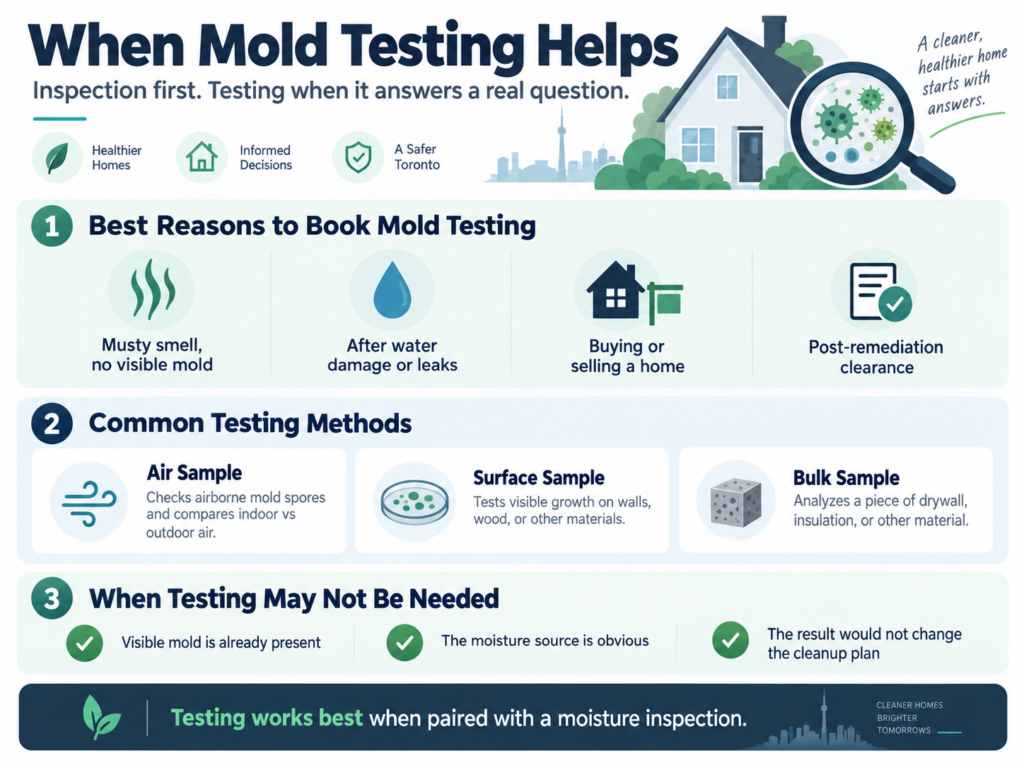
Mold testing is not always worth the cost.
You may not need testing when:
- Mold is clearly visible
- The affected material already needs removal
- A roof leak or pipe leak is obvious
- The mold is small and on a hard surface
- The main issue is moisture correction
- The test result will not change the cleanup plan
For example, if drywall is wet, soft, and visibly moldy, a lab report may only confirm what is already clear. The drywall needs safe removal, the moisture source needs repair, and the area needs drying.
Testing can be useful.
Guessing with test kits is not the same as solving the problem.
What Air Testing Can and Cannot Tell You
Air testing collects airborne spores from indoor air at one point in time.
A typical test uses a calibrated pump and sampling cassette. The sample is sent to a lab, where the spores are counted and identified by type. Indoor samples are often compared with an outdoor sample collected the same day.
Air testing can help show:
- Whether indoor spore levels are elevated compared with outdoor air
- Which mold types were found in the air
- Whether one area of the home has higher counts than another
- Whether hidden mold may be contributing to indoor air conditions
- Whether conditions improved after remediation
Air testing cannot always tell you:
- Exactly where the mold is growing
- How long the mold has been present
- Whether the mold is inside a wall
- Whether the home is safe for every person
- Whether the moisture source has been fixed
- Whether no mold exists anywhere in the home
Air testing gives data.
Inspection gives context.
You need both for a useful decision.
Common Mold Testing Methods
Different testing methods answer different questions.
| Testing Method | How It Works | Best Used For | Main Limitation |
|---|---|---|---|
| Air sampling | Air is pulled through a cassette and analyzed by a lab | Hidden mold concerns, indoor vs outdoor comparison | Results change with airflow, weather, activity, and sampling location |
| Surface sampling | A swab or tape lift is taken from visible growth | Confirming what is growing on a surface | Does not show what is in the air |
| Bulk sampling | A small piece of material is collected | Testing drywall, insulation, carpet, or wood | Requires disturbing or removing material |
| Dust sampling | Dust is collected for lab analysis | Longer-term contamination clues | Interpretation can be complex |
| Post-remediation sampling | Samples are taken after cleanup | Clearance support | Must be planned properly to be useful |
The best test depends on the question.
A musty basement with no visible mold may need air samples and moisture mapping.
A black stain on attic sheathing may need inspection first.
A real estate deal may need documentation before and after cleanup.
Mold Testing Cost in Toronto
Mold testing cost in Toronto depends on property size, number of samples, sample type, lab fees, report detail, and whether a full inspection is included.
DIY Mold Test Kits vs Professional Mold Inspection
DIY mold test kits are popular because they are cheap and easy to buy.
They can also be misleading.
Many kits collect spores that naturally exist in indoor and outdoor air. A positive result does not always mean you have a serious indoor mold problem. It may only show that mold spores landed on the plate.
DIY kits often miss the important questions:
- Where is the moisture coming from?
- Is mold growing indoors or entering from outside?
- Is the affected material porous?
- Are indoor counts elevated compared with outdoor air?
- Is the issue active or old?
- What should be removed, cleaned, or repaired?
Professional testing is different because the sampling plan is built around the home.
A good inspector considers room conditions, outdoor control samples, moisture readings, visible damage, airflow, building history, and the reason for testing.
The value is not only the lab result.
How Mold Testing Is Performed in a Home
When homeowners request mold testing, the process usually begins with a visual inspection of the property. A trained mold inspector looks for signs of moisture, water damage, or visible mold growth in areas where mold commonly develops.
This inspection step is important because mold problems are rarely random. Mold tends to grow where moisture persists, such as bathrooms, basements, crawl spaces, attics, or areas affected by plumbing leaks.
During the inspection, the technician may check several conditions inside the home:
- • humidity levels
- • condensation on windows or walls
- • water stains on ceilings or drywall
- • ventilation issues in bathrooms or kitchens
- • musty odors that indicate hidden mold
If signs of possible contamination are found, samples are collected for laboratory analysis.
What Happens During a Professional Mold Test?
A proper mold testing appointment should follow a clear process.
1. Homeowner interview
The technician asks about leaks, floods, smells, symptoms, past cleaning, renovations, and where the concern started.
2. Visual inspection
The inspector checks common mold areas such as basements, attics, bathrooms, crawl spaces, under sinks, around windows, laundry rooms, and areas with water damage.
3. Moisture and humidity review
Moisture meters, humidity readings, and sometimes thermal imaging may be used to locate damp areas or risk conditions.
4. Sampling plan
The technician decides whether air, surface, bulk, or post-remediation samples are useful.
The sampling plan should match the concern.
5. Sample collection
Samples are collected using proper equipment and handling procedures.
6. Lab analysis
Samples are sent to a qualified laboratory for analysis.
7. Report and recommendations
The report should explain what was found, what it means, and what the next step should be.
A report that only lists spore names and numbers is incomplete if no one explains the result in plain language.
What Should a Mold Testing Report Include?
A useful mold testing report should include:
- Reason for testing
- Areas inspected
- Moisture findings
- Temperature and humidity readings where relevant
- Sampling locations
- Sample type
- Outdoor control sample if air testing was done
- Lab results
- Mold types identified
- Spore counts for air samples
- Photos when needed
- Interpretation in plain language
- Recommended next steps
The report should not scare you with mold names without explaining the scope.
Benefits of Mold Testing for Homeowners
Mold testing provides valuable information when homeowners suspect a mold problem but cannot see the full extent of the issue.
In many homes, mold grows in hidden areas such as behind drywall, beneath flooring, or inside ventilation systems. Testing helps determine whether spores from hidden mold colonies are circulating through indoor air.
One of the main benefits of mold testing is that it removes guesswork. Instead of relying on assumptions, homeowners receive laboratory data that shows what is actually present in the home.
Key Benefits of Mold Testing
- • Identifying hidden mold problems
Testing can reveal mold contamination even when visible growth is not obvious. - • Understanding mold levels indoors
Air sampling compares indoor mold levels with outdoor air to determine whether indoor growth is occurring. - • Identifying mold species
Laboratory results may identify mold types such as Aspergillus, Penicillium, or Cladosporium. - • Supporting remediation decisions
Test results help determine whether professional mold removal is necessary. - • Improving indoor air quality awareness
Homeowners gain a clearer understanding of environmental conditions inside their home.
Mold testing can also be useful after flooding, water damage, or plumbing leaks. These situations often create the damp conditions that mold needs to grow, sometimes in areas that remain hidden for weeks.
Another common reason for mold testing is when occupants experience unexplained respiratory symptoms such as coughing, congestion, or sinus irritation that may be linked to poor indoor air quality.
In these cases, testing provides useful information that helps determine whether mold may be contributing to the problem.
What To Do After a Positive Mold Test
A positive mold test does not always mean panic.
Mold spores are common in the environment. The important question is whether the result suggests indoor mold growth, elevated contamination, or a moisture source that needs action.
After a positive test:
- Review the report with the inspector.
- Confirm whether indoor results are higher than outdoor control levels.
- Identify the most likely source area.
- Check moisture conditions.
- Decide whether materials can be cleaned or must be removed.
- Fix leaks, humidity, condensation, or ventilation problems.
- Complete mold removal or remediation if needed.
- Consider clearance testing if documentation is required.
The final step should always include moisture correction.
If the moisture source stays, mold can return even after professional mold cleanup.
Mold Testing for Real Estate
Mold testing can be useful during a home purchase when there are warning signs.
Common red flags include:
- Musty basement smell
- Attic staining
- Water stains on ceilings
- New paint in one isolated area
- Past flooding
- Foundation seepage
- Bathroom fan venting into the attic
- Condensation on windows
- Mold-like staining behind furniture
- Home inspection notes about moisture or microbial growth
For buyers, testing may help support negotiation or a remediation request.
For sellers, testing and documentation may reduce surprises during the inspection period.
For agents, a clear report can help keep the deal moving when moisture concerns appear.
Mold Testing for Rentals and Landlord Disputes
Mold testing may be helpful when a tenant and landlord disagree about the source or severity of a suspected mold problem.
Testing can document conditions, but it should not replace repair.
If there is a leak, water damage, or visible mold, the main action is still to fix the moisture source and remove affected materials safely.
Tenants should keep photos, dates, written notices, and repair records.
Landlords should document inspections, repairs, moisture correction, and remediation steps.
Mold Testing After Remediation
Post-remediation testing is used after mold cleanup to check whether conditions improved.
This is often requested for:
- Real estate transactions
- Insurance documentation
- Rental properties
- Commercial spaces
- Larger remediation projects
- Peace of mind after hidden mold removal
Clearance testing should happen after the work area is cleaned, dried, and visually reviewed.
Testing too early can create confusing results.
Where Mold Testing Helps Most in Toronto Homes
Toronto homes often have repeat moisture patterns.
Testing may be useful in:
- Finished basements with musty odours
- Older homes with hidden leaks
- Attics with black roof sheathing stains
- Cold rooms with condensation
- Bathrooms with recurring ceiling mold
- Condos with water damage from neighbouring units
- Rental units with unresolved moisture complaints
- Homes being bought or sold
- Areas where mold was cleaned but keeps returning
Testing works best when it is paired with a moisture investigation.
That is how you move from guessing to solving.
How To Prepare for Mold Testing
Before your appointment:
- Do not clean the area right before testing
- Do not spray bleach, vinegar, or chemicals on the suspected mold
- Keep windows closed unless your inspector says otherwise
- Avoid running air purifiers before air sampling unless instructed
- Make a list of leaks, floods, smells, and symptoms
- Take photos of areas that changed over time
- Keep access open to basements, attics, closets, and utility rooms
The inspector needs normal conditions to understand what is happening inside the home.
How We Approache Mold Testing
Ultimate Mold Crew does not treat mold testing as a one-size-fits-all service.
We start with the problem.
If testing will help confirm hidden contamination, support a report, guide remediation, or document the result after cleanup, we recommend the right sampling method.
If visible mold already tells us the material needs removal, we explain that too.
Our goal is to help homeowners make the right decision without paying for testing that does not change the outcome.
How to Prevent Mold Growth in Your Home
Mold testing can identify contamination, but preventing mold growth in the first place is always the best approach. Mold needs three main conditions to grow: moisture, organic material, and limited airflow.
Building materials such as drywall, wood, insulation, and carpet provide the organic material mold feeds on. When moisture enters these materials and remains for long periods, mold colonies can begin forming within 24 to 48 hours.
The key to prevention is controlling moisture inside the home.
Practical Steps to Prevent Mold Growth
• Control indoor humidity
Keep humidity levels below 50 percent whenever possible. Dehumidifiers can help reduce moisture in basements and lower levels of the home.
• Improve ventilation in moisture-prone areas
Bathrooms, kitchens, and laundry rooms generate large amounts of humidity. Exhaust fans help remove moist air before it settles on surfaces.
• Fix plumbing leaks quickly
Even slow leaks under sinks or inside walls can create damp environments where mold develops unnoticed.
• Dry wet areas immediately
After spills, flooding, or water leaks, materials should be dried within 24 to 48 hours to prevent mold growth.
• Maintain proper attic ventilation
Poor attic airflow can cause condensation on roof sheathing during winter months, which can lead to mold in insulation and wooden framing.
• Monitor basement moisture
Basements are one of the most common areas for mold because they are naturally cooler and more humid than upper floors.
Routine home maintenance plays an important role in mold prevention. Addressing water damage early and maintaining proper airflow throughout the home significantly reduces the chances of mold growth.
Final Takeaway
Mold testing is useful when it answers a clear question.
It can help with hidden mold, musty odours, water damage, real estate concerns, rental disputes, insurance documentation, and post-remediation clearance.
But testing is not always needed when mold is visible.
In many cases, the better first step is a mold inspection that finds the moisture source and identifies what materials are affected.
The safest approach is simple:
- Inspect first.
- Test when the result matters.
- Fix the moisture source.
- Remove mold safely.
- Prevent it from coming back.
GET EMERGENCY HELP
Ultimate Mold Crew – Mold Removal Toronto
FAQs About Mold Testing in Toronto
Is mold testing worth it?
Mold testing is worth it when the source is hidden, the smell is unexplained, documentation is needed, or the result will change the remediation plan. It may not be needed when visible mold already needs removal.
How much does mold testing cost in Toronto?
Mold testing in Toronto often ranges from $250 to $900 for residential testing, depending on the number of samples, property size, lab fees, and whether a full inspection is included.
Is air testing for mold accurate?
Air testing can provide useful data, but it is only a snapshot of indoor air at the time of sampling. Results can change with airflow, weather, activity, ventilation, and sampling location.
Should I test visible mold?
Usually, visible mold does not need testing before action. If the material is contaminated, the priority is moisture correction and safe removal or cleaning.
What is the difference between mold inspection and mold testing?
A mold inspection looks for moisture, damage, visible growth, odours, and risk areas. Mold testing collects samples for lab analysis.
Can a mold test find hidden mold?
Air testing may suggest hidden mold when indoor spore levels are elevated or unusual compared with outdoor air. It should be paired with inspection and moisture checks.
Do DIY mold test kits work?
DIY kits may show that mold spores are present, but mold spores are common. They often do not explain the source, severity, or next step.
How long do mold test results take?
Many lab results take a few business days, depending on the lab, sample type, and urgency.
Is mold testing needed after remediation?
Post-remediation testing can be useful when documentation is required for a buyer, landlord, insurer, property manager, or homeowner peace of mind.
What happens if mold test results are high?
The next step is to review the result with the inspector, identify the likely source, check moisture conditions, and decide whether remediation is needed.
Research-Based Citations for Mold Testing and Sampling
- Centers for Disease Control and Prevention (CDC) – Mold and Health
https://www.cdc.gov/mold - U.S. Environmental Protection Agency (EPA) – Mold, Moisture and Your Home
https://www.epa.gov/mold/mold-moisture-and-your-home - World Health Organization – WHO Guidelines for Indoor Air Quality: Dampness and Mould
https://www.who.int/publications/i/item/9789289041683 - Health Canada – Mould and Your Health
https://www.canada.ca/en/health-canada/services/air-quality/mould-health.html - National Institute of Environmental Health Sciences – Mold and Health Effects
https://www.niehs.nih.gov/health/topics/agents/mold - Environmental Protection Agency – Guide to Mold Cleanup After Floods
https://www.epa.gov/mold/mold-cleanup-your-home - Canadian Centre for Occupational Health and Safety – Indoor Air Quality and Mold
https://www.ccohs.ca/oshanswers/biol_hazards/iaq_mold.html
| # | Peer Reviewed Research Papers | Key Focus |
|---|---|---|
| 1 | AIHA (2024). Mold and Dampness in the Built Environment: Position Statement. | The primary industry position statement from the American Industrial Hygiene Association (AIHA) on managing mold and dampness to protect occupant health. |
| 2 | CDC (2025). Mold, Testing, and Remediation Guidelines. | Official federal guidance from the CDC and NIOSH regarding the role of air sampling and the importance of identifying moisture sources in building evaluations. |
| 3 | Volf, C., et al. (2024). Correlating surface mold contamination with airborne pollution. | Peer-reviewed research in Building and Environment examining the release dynamics of surface mold and its impact on indoor air quality. |
| 4 | Barrett, J., & Gonzalez, O. (2024). Testing for Mold Growth: Professional Safety Analysis. | Technical review of sampling methodologies, including the comparative effectiveness of bulk, surface, and air sampling in professional mold assessments. |
| 5 | Summerbell, R., & Scott, J. (2025). Emerging Human Health Problems Caused by Pathogenic Fungi. | Academic research detailing the health risks associated with indoor fungal exposure and the clinical implications of pathogenic mold species. |
| 6 | Salehi, P., et al. (2025). Integrating Household Characteristics and Mold Inspection Data. | Study on developing localized mold-risk profiles by combining building inspection data with occupant awareness and remediation outcomes. |
| 7 | Borchers, A. T., et al. (2017). Mold and Human Health: A Reality Check. | Comprehensive clinical review of the relationship between indoor mold exposure, musty odors, and the prevalence of respiratory symptoms. |
