

Updated on 22-Sep-2026
Ever noticed a musty smell in your home or strange symptoms that seem to come and go?
In this article you will get answers to all of your questions such as
- how do i know if mold is making you sick?
- can mold cause fatigue?
- can mold cause headaches?
- does mold cause brain fog?
- how long do mold exposure symptoms last?
- can i test my body for mold?
- is black mold more dangerous?
- should i test mold species?
- when should i see a doctor for mold exposure?
Mold is a common yet often overlooked problem in homes and buildings, and it can have serious health implications if not addressed promptly.
Mould exposure can affect people in different ways. Some people notice no symptoms. Others develop nasal congestion, coughing, irritated eyes, skin irritation, wheezing or worsening asthma after spending time in a damp or mould-affected building.
The phrase “mold toxicity” is widely used online to describe symptoms people associate with indoor mould or mycotoxin exposure. It is important to understand what that term means.
Indoor mould can release spores, fragments, allergens and irritants. Certain moulds can also produce compounds called mycotoxins under specific environmental conditions. However, symptoms alone cannot prove that mould or mycotoxins caused an illness.
Health Canada considers indoor mould growth a potential health hazard and recommends removing visible mould and correcting the moisture problem that allowed it to grow.
At Ultimate Mold Crew, we approach suspected mould-related health concerns from the building side. We look for the conditions that support mould growth, including water intrusion, damp drywall, condensation, basement moisture, roof leaks and poor ventilation.
If you are experiencing persistent or serious health symptoms, speak with a healthcare professional. If your home has visible mould, a recurring musty odour or a history of water damage, the building should also be investigated.
Let’s dive in!
Table of Contents
What Is Mold Toxicity?
“Mold toxicity” is a popular term used to describe health symptoms that someone believes are connected to mould, damp indoor conditions or compounds produced by certain moulds.
From a medical standpoint, it helps to separate several different types of mould-related health effects.
| Mold-related issue | What it means | Examples |
|---|---|---|
| Irritation | Mould particles or compounds irritate tissues | Burning eyes, sore throat, coughing |
| Mold allergy | The immune system reacts to mould allergens | Sneezing, congestion, itchy eyes, skin reactions |
| Asthma response | Mould exposure triggers or worsens asthma | Wheezing, chest tightness, shortness of breath |
| Hypersensitivity pneumonitis | An uncommon immune-mediated lung reaction | Cough, breathlessness, fever-like symptoms |
| Fungal infection | Certain fungi infect tissue, mainly in highly vulnerable people | Lung infections in severely immunocompromised individuals |
| Mycotoxin exposure | Exposure to toxic metabolites produced by some mould species under certain conditions | Health significance depends on toxin, dose and route of exposure |
This distinction matters because finding mould in a building does not automatically mean someone has “mycotoxicosis.”
Researchers continue to study other symptoms sometimes attributed to indoor mould. Symptoms such as fatigue, headache, poor concentration and dizziness are real symptoms, but they are non-specific and can have many possible causes. They should not be used alone to diagnose mould-related illness.
What Are Mycotoxins?
Mycotoxins are secondary metabolites that some mould species can produce.
Mould genera capable of producing certain mycotoxins include Aspergillus, Penicillium, Fusarium and Stachybotrys. Production depends on the particular species or strain, moisture, temperature, substrate and other environmental conditions.
The presence of a potentially toxigenic mould therefore does not prove that clinically significant concentrations of mycotoxins are present.
For homeowners, the practical response remains the same: find the moisture source and address indoor mould growth rather than trying to determine whether a visible colony is “toxic.”
Mold toxicity occurs when individuals are exposed to large quantities of mold spores and mycotoxins over a period, leading to various health issues.
These can range from mild allergic reactions to more severe health conditions. It’s important to recognize the early signs of mold toxicity to prevent prolonged exposure and its health risks.
10 Warning Signs That Mold Exposure May Be Affecting You or Your Home
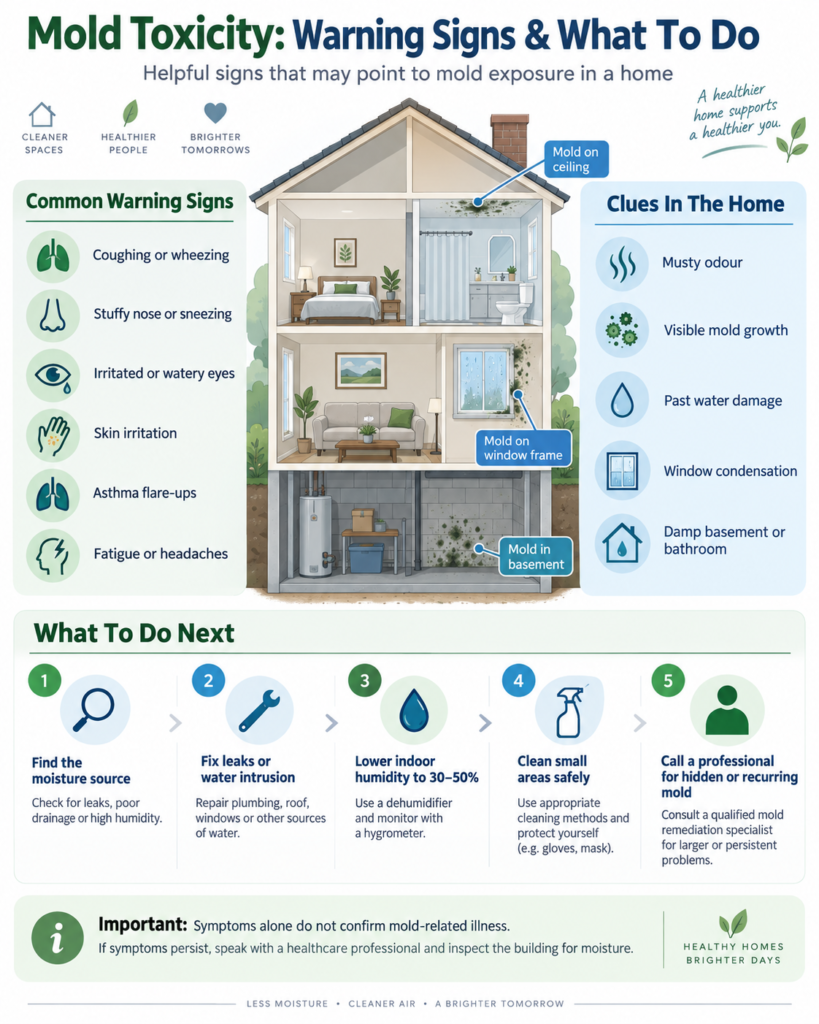
Source – Dr. Peter Osborne
Mold toxicity can manifest in various ways, affecting different parts of your body and overall well-being.
Recognizing these symptoms early can help you take timely action and prevent more severe health issues.
Here are some common symptoms to watch out for:
1. Persistent Respiratory Problems
Do you find yourself coughing, sneezing, or having difficulty breathing, especially when you’re at home? These persistent respiratory issues could be a sign of mold presence. Mold spores can irritate your airways, leading to chronic respiratory problems that don’t seem to go away with regular treatments.
2. Unexplained Allergies or Asthma Flare-Ups
Allergies or asthma can worsen due to mold exposure. If you notice an increase in allergy symptoms or asthma attacks, consider checking your home for mold, particularly in damp areas.
3. Skin Irritation
Mold exposure can also lead to skin irritation, including rashes and hives. If you notice unexplained skin issues, mold toxicity might be the culprit. Prolonged mold exposure can cause dermatitis, leading to itchy, inflamed skin. The irritation can be exacerbated in individuals with sensitive skin or allergies. If you find these skin problems persist or worsen after spending time in certain areas of your home, it may be time to investigate for mold. It’s also worth noting that some individuals may experience more severe reactions, such as swelling or intense itching.
4. Fatigue or Feeling Unwell in a Damp Building
Fatigue is sometimes reported by people concerned about indoor mould exposure, but fatigue has many possible causes and is not specific enough to diagnose a mould-related illness.
The useful clue is the environmental pattern.
If symptoms repeatedly become worse in one damp or musty building and improve after leaving, that pattern may justify investigating the building for moisture and mould while also discussing persistent symptoms with a healthcare provider.
5. Headaches or Other Non-Specific Symptoms
Headaches are frequently mentioned by people who suspect a mould problem, but headaches have many causes. Indoor air quality, allergens, odours, ventilation, carbon monoxide, volatile organic compounds and underlying medical conditions can produce overlapping symptoms.
A headache by itself does not establish mould exposure.
If headaches consistently occur in the same damp building, look for objective environmental clues such as water damage, visible mould, condensation and persistent musty odours.
6. Brain Fog or Difficulty Concentrating
People searching for mold toxicity frequently report “brain fog,” poor concentration or memory problems.
These symptoms deserve medical attention when persistent, but they are not specific to mould exposure.
Current clinical evidence does not support diagnosing indoor mould-related toxicity based on cognitive symptoms alone. A healthcare professional should evaluate ongoing neurological or cognitive symptoms while any confirmed dampness or mould problem in the building is corrected.
This satisfies the search query without presenting disputed causality as established fact.
The 2023 clinical guideline specifically lists neuropsychological and neurotoxic effects among areas where evidence for an indoor mould association remains insufficient.
7. Eye Irritation
Are your eyes red, watery, or itchy? Persistent eye irritation can be a common reaction to mold exposure. If you’re experiencing persistent eye irritation, consider the possibility of mold presence in your environment. This irritation can also be accompanied by blurred vision or a gritty feeling in the eyes as if something is in them. In severe cases, you may experience swelling or sensitivity to light. These symptoms can significantly affect your day-to-day activities and comfort. Regularly cleaning areas where mold thrives and improving ventilation can help reduce eye irritants.
8. Symptoms Change Depending on Where You Spend Time
One useful clue is whether symptoms follow the environment.
Someone may notice congestion, coughing or irritated eyes while spending time in a damp basement, bedroom, office or other affected area and feel better after leaving.
That pattern does not prove mould caused the symptoms. It does provide a reason to inspect the building for moisture, visible mould and other indoor air quality problems.
9. Unusual Odors
Have you noticed a musty or earthy smell in your home? These unusual odors often indicate mold growth. If you detect unexplained odors, it’s important to investigate and address potential mold issues promptly. Health Canada specifically recommends checking for a musty or earthy odour because mould can sometimes be hidden from view.
10. Visible Mold Growth
Have you spotted visible mold growth in your home? This is a clear sign of a mold problem. If you see mold, it’s crucial to address it immediately to prevent further health risks and property damage. Visible mould does not need to be black to deserve attention.\
Which Mold Exposure Symptoms Have the Strongest Scientific Evidence?
People searching for mold toxicity often encounter very long symptom lists online. The evidence is stronger for some health effects than for others.
| Symptom or condition | Current evidence related to indoor mould |
|---|---|
| Eye, nose and throat irritation | Strongly recognized |
| Coughing and wheezing | Strongly recognized |
| Shortness of breath | Recognized |
| Mold allergy symptoms | Recognized |
| Worsening asthma | Strongly recognized |
| Hypersensitivity pneumonitis | Recognized but uncommon |
| Fungal infection | Primarily a concern for severely immunocompromised people |
| Headaches | Non-specific |
| Fatigue | Non-specific |
| Brain fog or memory problems | Evidence is less certain for routine indoor mould exposure |
| Systemic “toxic mold syndrome” | Not established as a single diagnostic condition |
The important distinction is association versus diagnosis.
A symptom may occur while someone is living in a damp building without proving that mould caused that particular symptom.
For this reason, health symptoms should be assessed medically while the building is evaluated separately for moisture and mould.
Who Is More Vulnerable to Indoor Mold?
Indoor mould deserves additional attention when a home includes:
- infants or young children
- seniors
- people with asthma
- people with severe allergies
- people with chronic respiratory conditions
- people with severely weakened immune systems
Health Canada states that susceptibility varies considerably between individuals. This is one reason there is no single indoor mould concentration that can be labelled safe for everyone.
People with severe immune suppression require special caution because some airborne fungi can cause serious lung infections in vulnerable individuals.
Is Black Mold More Toxic Than Other Mold?
Black colour alone does not tell you how dangerous a mould is.
Stachybotrys chartarum is a greenish-black mould that can grow on wet cellulose-rich materials such as drywall, paper and fibreboard. Certain strains are capable of producing mycotoxins under suitable conditions.
That does not mean every Stachybotrys colony is actively producing dangerous levels of toxins.
The CDC recommends treating Stachybotrys and other indoor mould growth from a practical building perspective: locate the water or moisture problem and remove the mould.
Black mould is not automatically more dangerous than mould of another colour. Colour is therefore a poor way to judge health risk or determine the remediation plan.
Mold Spores, Allergens and Mycotoxins Are Different Things
These terms are often mixed together online.
Mold spores are microscopic reproductive structures that can become airborne.
Mold fragments are pieces of fungal material that may also become airborne.
Allergens are substances capable of triggering an allergic immune response.
Irritants can irritate the eyes, nose, throat, skin or respiratory tract.
Mycotoxins are chemical metabolites that certain fungi can produce under particular environmental conditions.
Someone can react to mould without being exposed to clinically significant concentrations of mycotoxins.
This is why the presence of respiratory or allergy symptoms should not automatically be labelled “mycotoxin poisoning.” Symptoms alone cannot diagnose illness caused by indoor mould
Can You Test Your Body for Mold Toxicity?
There is currently no simple consumer test that can prove that indoor mould is causing a person’s symptoms.
Urine mycotoxin tests are available commercially, but major public health and clinical guidance has raised concerns about using these tests to diagnose illness caused by indoor mould exposure. Mycotoxins can also enter the body through food, and disease-predicting urine thresholds have not been established.
A physician may instead use a person’s medical history, physical examination and, where appropriate, established tests for conditions such as mould allergy, asthma or fungal infection.
Testing the building and diagnosing the patient are two separate questions.
The presence of a potentially toxigenic mould does not prove that mycotoxins are being produced.
Do You Need Air Testing to Know You Have a Mold Problem?
Usually, no.
Health Canada states that routine air testing for mould is generally unnecessary when visible mould or a clear moisture problem is already present.
An air sample also cannot tell you whether mould is causing a person’s health symptoms.
The first investigation should usually focus on:
- visible mould growth
- musty odours
- previous flooding or water damage
- plumbing or roof leaks
- wet building materials
- condensation
- relative humidity
- hidden moisture inside walls or ceilings
Air or surface sampling may still have a role in specific cases, especially when an experienced inspector is investigating suspected hidden growth or trying to answer a defined question.
The test should support the investigation rather than replace it.
What We Look for in Toronto Homes
During mould investigations and remediation work, we usually find that the most useful question is not
The useful question is “Where is the moisture coming from?”
In Toronto and GTA homes, mould problems commonly develop around:
- damp basements and foundation walls
- previous plumbing leaks
- roof and attic moisture
- bathroom humidity
- window condensation
- wet drywall
- poorly ventilated rooms
- water-damaged insulation
- hidden wall and ceiling cavities
Mould needs moisture to continue growing. Removing surface growth without correcting that moisture source gives the problem an opportunity to return.
What Should You Do If You Suspect Mold Is Affecting You?
Treat the health issue and building issue as two separate investigations.
If symptoms are persistent, worsening or serious, speak with a healthcare professional. This is particularly important for people with asthma, chronic lung disease or significantly weakened immune systems.
For the building:
- Look for visible mould and water staining.
- Check for a persistent musty smell.
- Identify recent leaks, flooding or condensation.
- Measure indoor humidity.
- Find and correct the source of moisture.
- Assess how large the mould-affected area is.
- Remove contaminated materials safely when required.
- Consider professional mold remediation for extensive, hidden or recurring growth.
Maintain indoor relative humidity between approximately 30% and 50% and correcting moisture problems promptly.
When Does Mold Need Professional Remediation?
| Approximate extent | Health Canada classification |
|---|---|
| 1 to 3 patches, each under 1 m² | Small |
| More than 3 patches, or areas between 1 m² and 3 m² | Medium |
| More than 3 m² | Extensive |
Professional help becomes especially useful when mould is extensive, repeatedly returns after cleaning, follows major water damage, or is hidden inside walls, ceilings, insulation or other building assemblies.
The moisture problem must be corrected during remediation. Otherwise, mould can grow again.
Mold Testing and Inspection
While identifying mold by color can provide initial clues, professional testing is essential for accurate identification. Mold testing involves collecting samples and analyzing them in a laboratory to determine the exact species and potential health risks. If you suspect mold growth in your home, it’s crucial to get professional mold testing and inspection.
For more information, visit our mold testing and mold inspection pages.
Mold Toxicity Concerns Should Start With the Building
People searching for mold toxicity are usually trying to answer two questions: Could my environment be contributing to how I feel, and what should I do next?
Indoor mould and dampness have documented links with respiratory irritation, allergic reactions and worsening asthma. Other symptoms often discussed online, including fatigue, headaches and brain fog, are less specific and require proper medical evaluation.
From the building side, the response is clearer.
If mould is visible, repeatedly returns, smells musty or follows water damage, find the moisture source and correct it. The species or colour of mould rarely changes that basic requirement.
At Ultimate Mold Crew, we inspect and remediate mould problems across Toronto and the GTA with the focus on finding the source, defining the affected area and preventing the same moisture conditions from allowing the growth to return.
Mold Toxicity FAQs
Is black mold the most dangerous mold?
No single mould colour can determine health risk. Stachybotrys chartarum can produce mycotoxins under some conditions, but the presence of dark or black mould does not prove toxin production. Any significant indoor mould growth indicates a moisture problem that should be corrected.
What are the first signs that mold may be affecting you?
Commonly recognized effects include nasal congestion, irritated eyes, coughing, wheezing, throat irritation and worsening asthma symptoms. Symptoms vary between people, and these symptoms can have causes unrelated to mould.
How do you know if mold is making you sick?
Symptoms alone cannot confirm that mould is causing illness. A healthcare professional can evaluate your symptoms. At the same time, inspect your home for visible mould, musty odours, moisture, leaks and water damage.
Can mold cause fatigue or brain fog?
People sometimes report fatigue or concentration problems in mould-affected buildings, but these symptoms are non-specific. Current evidence is much stronger for respiratory, allergic and irritation effects. Persistent fatigue or cognitive symptoms should be evaluated medically.
How long do symptoms from mold exposure last?
There is no single timeline. It depends on the type of reaction, degree of exposure, individual sensitivity and underlying health conditions. Allergy or irritation symptoms may improve after exposure decreases, while persistent respiratory symptoms require medical evaluation.
Can I test myself for mold toxicity?
There is no validated home test that can establish that indoor mould caused your symptoms. Commercial urine mycotoxin testing should not be treated as proof of illness from a mouldy building.
Should I test the mold to find out what species it is?
Usually, visible mould does not need species identification before it is addressed. Health Canada recommends finding the moisture source and removing the mould. Sampling can be useful in selected investigations when it answers a specific question.
When should I call a mold remediation company?
Consider professional assessment when mould is extensive, hidden, recurring, associated with substantial water damage, growing inside wall or ceiling assemblies, or difficult to remove safely.
Mold Toxicity Research Papers and Publications
- “The Medical Effects of Mold Exposure” JACI Online
- “Environmental Mold and Mycotoxin Exposures Elicit Specific Cytokine and Chemokine Responses” PLOS Journals
- “Spectrum of Noninfectious Health Effects From Molds” AAP Publications
- “Mold and Human Health: A Reality Check” Springer Link
- “Mold Allergy” JACI Online
Other Sources
