

Updated on 25-Aug-2026
Dark staining across attic plywood can look alarming, especially when you first notice it during a roof inspection, insulation upgrade, or home sale.
The first instinct is often to ask what you can spray on it.
That is rarely the most important question.
Mold on attic plywood is removed by correcting the moisture problem first, then cleaning or remediating the affected wood using a method appropriate for the extent of growth and condition of the sheathing.
Plywood that remains structurally sound can often be remediated. Sheathing that has softened, delaminated, rotted, or otherwise lost structural integrity may need replacement.
The moisture source is what determines whether the mold comes back.
In Toronto attics, we commonly look for:
- Warm indoor air leaking through the attic floor
- Bathroom exhaust ducts terminating or leaking into the attic
- Poorly sealed attic hatches
- Plumbing and electrical penetrations
- Pot lights and ceiling penetrations
- Blocked soffit ventilation
- Roof or flashing leaks
- Wet insulation
- Condensation or frost on roof sheathing
- Uneven insulation near exterior walls
This distinction matters.
Cleaning plywood without fixing the moisture source can make an attic look better for a while. It does not solve the building condition that allowed the mold to grow.
Table of Contents
Can Mold Be Removed From Attic Plywood?
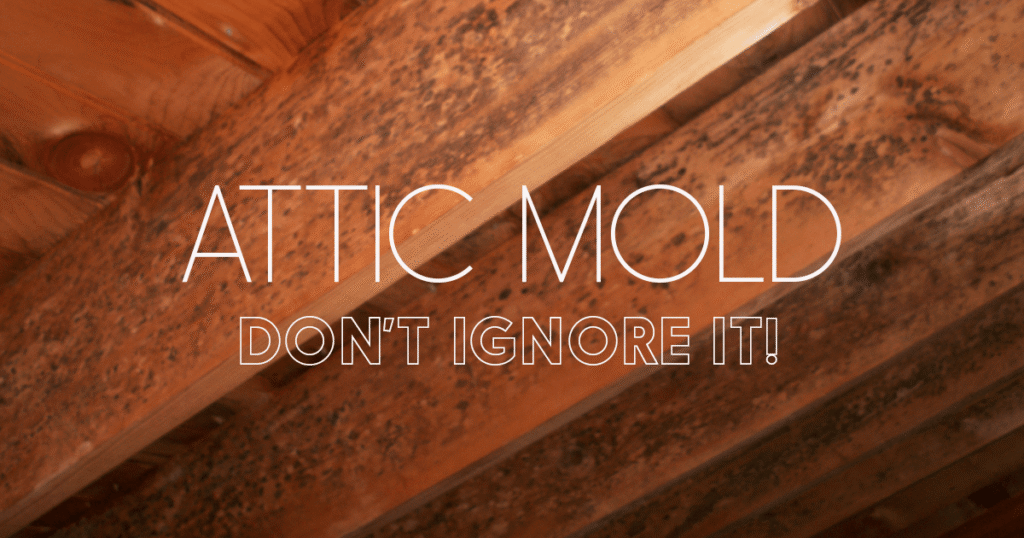
Yes, mold can often be removed from attic plywood when the wood remains structurally sound and the contamination is suitable for remediation.
| Condition of Attic Plywood | Typical Meaning | Likely Next Step |
|---|---|---|
| Surface mold, plywood is dry and solid | Growth may be limited to the wood surface | Correct moisture source and remediate the sheathing |
| Dark staining but no active growth | Previous mold or moisture may have permanently discoloured the wood | Confirm dryness and evaluate whether active contamination remains |
| Mold returns after previous cleaning | Moisture source is probably still active | Investigate condensation, leaks, ventilation and air leakage |
| Plywood is soft or delaminating | Moisture has damaged the sheathing | Roofing or structural evaluation may be needed |
| Plywood is sagging or decayed | Material may have lost structural integrity | Replacement may be required |
| Growth extends to rafters, trusses and insulation | Problem is larger than surface plywood contamination | Professional remediation assessment is recommended |
Surface Mold on Sound Plywood
If the plywood remains solid and the mold is primarily on the surface, professional remediation can often clean the existing sheathing.
The removal method depends on:
- How much of the roof deck is affected
- How dense the growth is
- Whether rafters or trusses are also affected
- Accessibility
- Insulation conditions
- Moisture levels
- The attic’s construction
- Whether contamination extends into other materials
Cleaning may involve HEPA-controlled procedures and mechanical removal of contamination from the wood surface.
Staining That Remains After Mold Removal
This causes a lot of confusion.
Clean wood does not always return to the colour it had when the house was built.
Mold and prolonged moisture can leave dark staining behind even after fungal growth has been removed. Conversely, a dark patch is not automatically active mold.
This is why judging remediation only by the colour of plywood can lead to bad decisions.
A useful assessment looks at:
Wood condition + Moisture + Visible growth + Source of moisture + Remediation history
rather than colour alone.
Deteriorated or Rotted Roof Sheathing
This is different.
Persistent moisture can eventually damage wood products. Natural Resources Canada warns that unresolved attic moisture can lead to structural deterioration, including wood rot and damage to rafters and sheathing.
Signs that plywood may need further structural evaluation or replacement include:
- Soft areas
- Delamination between plywood layers
- Sagging
- Crumbling or loss of material
- Significant decay
- Fasteners no longer holding properly
- Persistent saturation from an unresolved roof leak
At that point, cleaning the visible mold is only one part of the repair.
The roof assembly itself may need attention.
Why Does Mold Grow on Attic Plywood?
Mold needs moisture.
Attic plywood provides an organic surface, but dry roof sheathing does not normally develop widespread active mold simply because spores are present.
The more useful question is:
How is the plywood getting wet?
In Toronto, the answer often changes with the season.
During cold weather, warm household air can leak upward into a cold attic. When that warm, moisture-laden air contacts cold roof sheathing, water vapour can condense. Under colder conditions, frost can develop on the underside of the roof deck.
| What You Notice in the Attic | Possible Cause | What Should Be Checked |
|---|---|---|
| Widespread mold or frost across roof sheathing | Warm indoor air leaking into the attic | Attic hatch, ceiling penetrations, plumbing stacks, wiring and air sealing |
| Heavy growth near a bathroom exhaust duct | Leaking, disconnected or poorly terminated exhaust | Duct connections, insulation and exterior termination |
| Localized staining below one roof area | Roof or flashing leak | Shingles, valleys, flashing and roof penetrations |
| Mold concentrated near eaves | Restricted soffit airflow or insulation blocking vents | Soffits, baffles and insulation placement |
| Dark growth above rooms with missing insulation | Cold surface and uneven heat loss | Insulation depth, gaps and ceiling air leakage |
| Wet insulation below stained plywood | Active leak or condensation | Moisture source, insulation condition and surrounding sheathing |
1. Warm Air Leaking From the House
Air leakage is one of the most overlooked causes of attic moisture.
Warm indoor air can enter the attic around:
- Attic hatches
- Ceiling fixtures
- Plumbing stacks
- Electrical wiring
- Partition walls
- Chimney chases
- Exhaust fan penetrations
- Other gaps in the ceiling air barrier
Once moisture reaches cold plywood, condensation can occur.
This is why simply adding another roof vent does not necessarily solve attic mold.
Older CMHC guidance on wet attics makes an important point: increasing ventilation alone can sometimes fail to correct the problem because the real source is moist household air leaking into the attic. Air sealing is often the first part of the solution.
2. Bathroom Fans Venting Into the Attic
This is a condition we specifically look for.
A bathroom fan moves a large amount of humid air after showers and baths. If its duct terminates inside the attic, becomes disconnected, leaks at a joint, or discharges where moisture can return through nearby soffits, that moisture can end up on the roof sheathing.
Health Canada says bathroom exhaust fans should vent outside rather than into the attic.
The National Research Council of Canada has also documented attic moisture problems where bathroom and dryer exhausts discharged into attic spaces, along with restricted ventilation and uncontrolled air leakage.
If mold is concentrated near an exhaust duct, we investigate the duct before blaming the plywood.
3. Roof and Flashing Leaks
Not every attic mold problem starts inside the home.
Water can enter through:
- Damaged shingles
- Failed flashing
- Roof penetrations
- Plumbing vent flashings
- Valleys
- Chimneys
- Ice-dam related leakage
A roof leak often produces a more localized moisture pattern than whole-attic condensation, although every property is different.
Look for:
- Water staining
- Damp sheathing
- Staining along rafters
- Rusted fasteners
- Wet insulation below the affected area
- Damage concentrated below a roof penetration
A good attic assessment asks whether moisture is entering from above or from below before any mold-removal method is selected.
4. Blocked Soffit Ventilation
Attic ventilation still matters.
Problems can develop when loose-fill or batt insulation blocks the air path near the eaves or when vents are otherwise restricted.
NRCan advises checking that attic ventilation is present and that insulation has not blocked the ventilation path, particularly when heavy frost is found.
The important point is balance.
Ventilation does not replace air sealing. Air sealing does not mean ventilation can be ignored.
Both need to work with the attic assembly.
5. Uneven or Inadequate Insulation
Missing insulation can create cold areas at the ceiling and exterior-wall junction.
NRCan notes that poorly covered areas can become cold spots that contribute to moisture and mold problems.
Insulation problems can also appear around:
- Attic hatches
- Eaves
- Ceiling penetrations
- Changes in roof geometry
- Additions
- Older sections of a renovated home
Adding insulation before fixing an existing moisture problem is not the right order.
The attic should first be evaluated for leakage, condensation, wet materials and existing contamination.
Does Black Attic Plywood Mean You Have “Black Mold”?
No.
You cannot reliably identify a mold species from colour alone.
Mold growing on roof sheathing may appear:
- Black
- Dark brown
- Grey
- White
- Greenish
- Speckled
- Patchy
Dark staining can also remain after an older moisture event.
The term black mold is often used online as though every dark colony is Stachybotrys chartarum. That conclusion cannot be made visually.
For remediation purposes, the moisture source and extent of contamination usually matter more than the colour.
Testing can be useful in specific situations, but seeing dark plywood does not automatically mean attic air sampling is required.
Should You Use Bleach on Moldy Attic Plywood?
The old version of this article recommended mixing bleach with water and spraying the roof sheathing.
We no longer recommend that advice.
Health Canada’s current homeowner guidance states that mold on suitable surfaces can be cleaned using water and dish detergent and specifically says there is no need to use bleach.
There is also a larger problem with treating attic plywood remediation as a chemical-cleaning exercise.
Even if a product affects fungal organisms, it does not:
- Repair a leaking roof
- Seal ceiling air leaks
- Reconnect a bathroom exhaust duct
- Unblock soffit ventilation
- Remove contaminated insulation
- Restore damaged plywood
- Correct persistent condensation
And “killing” visible mold is not the same thing as physically removing contamination.
So if someone asks us:
“What should I spray on my attic plywood?”
our first response is usually:
“Before choosing a cleaner, find out why the plywood became damp.”
That gives you a much better chance of preventing the same growth from coming back.
Should You Put a Dehumidifier in a Moldy Attic?
Usually, a dehumidifier should not be treated as the default fix for a typical vented Toronto attic.
The previous article recommended installing one to control attic humidity. That advice oversimplifies how a cold attic is supposed to work.
Most conventional vented attics are intended to remain separated from the conditioned living space below.
When roof sheathing is repeatedly damp, we first investigate:
- Household air leakage
- Exhaust ducts
- Roof leakage
- Ventilation paths
- Insulation
- Air-barrier defects
NRCan specifically states that attic moisture problems should be identified and corrected before insulation work proceeds. It also emphasizes comprehensive air sealing where indoor moisture is escaping into the attic.
Running a portable dehumidifier does not repair any of these building defects.
It may also be impractical in an unconditioned attic because of temperature, drainage, power and equipment operating limits.
The right moisture-control strategy depends on the attic design.
Before You Try DIY Attic Mold Removal, Check the Insulation
This point was completely missing from the old article and is particularly important in older Toronto homes.
Some older attics contain vermiculite insulation.
Certain vermiculite products installed in Canada may contain asbestos. Health Canada advises homeowners not to disturb vermiculite insulation and recommends qualified professional help where asbestos-containing material may be affected.
If you see loose, pebble-like vermiculite insulation in an attic:
Do not start vacuuming, brushing, sanding or moving the insulation yourself.
Attic mold work can disturb material below the roof sheathing as workers move through the space. That changes the safety requirements before mold remediation even begins.
Other attic hazards can include:
- Exposed nails
- Limited walking surfaces
- Electrical wiring
- Low clearances
- Heat stress
- Contaminated insulation
- Difficult access
- Fall-through risks between ceiling joists
This is one reason a seemingly straightforward “clean the plywood” project can be very different from cleaning a small mold spot in a bathroom.
Can You Remove a Small Amount of Attic Mold Yourself?
small and some medium mold areas can often be cleaned by homeowners using appropriate personal protection and containment precautions. It classifies extensive mold as an affected area larger than 3 m² and recommends considering professional help for large or recurring problems.
Attics require an additional layer of judgment.
The visible square footage is not the only issue.
Before attempting any work, consider:
- Can you safely reach the affected plywood?
- Is the insulation safe to disturb?
- Is mold limited to one small area?
- Do you know where the moisture came from?
- Is the plywood still solid?
- Does the mold extend across multiple roof slopes?
- Are rafters or trusses also affected?
- Is contaminated insulation present?
- Can dust and debris be controlled?
- Has the mold returned after previous cleaning?
A few isolated spots caused by a repaired roof leak are very different from widespread growth across an entire north-facing roof deck.
Once mold covers substantial portions of the sheathing, professional remediation generally becomes the more practical approach because removal has to be controlled without spreading contaminated dust through the attic or into the occupied home.
And that leads to the next question:
How is mold actually removed from attic plywood without replacing an otherwise sound roof deck?
How Is Mold Professionally Removed From Attic Plywood?
If the plywood is still structurally sound, replacing the entire roof deck is often unnecessary.
The goal is to remove fungal contamination from salvageable wood while preventing disturbed particles from spreading into insulation, the attic hatch, or occupied areas below.
The exact method depends on what we find.
A few patches on accessible sheathing may require a very different process from mold covering both roof slopes, rafters, and trusses.
Professional attic remediation normally involves several connected steps:
- Identify and correct the moisture source.
- Determine which plywood can be saved.
- Protect the home from contamination during the work.
- Physically remove mold from salvageable wood.
- Remove materials that cannot be adequately cleaned.
- HEPA-clean the remediation area.
- Confirm that the attic is dry and the original moisture condition has been addressed.
The EPA emphasizes the same basic remediation sequence: identify the water or moisture problem, clean and dry moldy materials, discard materials that cannot be cleaned, and check for moisture or mold returning after the work.
The cleaning technique is selected after the wood and extent of contamination are assessed.
Attic Plywood Mold Removal Methods Compared
| Remediation Method | Where It May Fit | Important Limitation |
|---|---|---|
| HEPA vacuuming and controlled surface cleaning | Light contamination, final cleanup, accessible wood surfaces | May not remove growth or staining embedded in the surface of unfinished plywood |
| HEPA-assisted sanding or mechanical abrasion | Structurally sound plywood with more established surface growth | Creates dust and requires proper containment and HEPA control |
| Abrasive media blasting | Larger or difficult wood surfaces where aggressive surface cleaning is justified | Can create substantial airborne particulate and requires strict engineering controls |
| Removal and replacement | Soft, delaminated, rotted, severely damaged or unsalvageable sheathing | Requires roofing or structural work in addition to mold remediation |
| Coating or encapsulation after remediation | Selected projects after wood has been cleaned and dried | Must never be used to cover active mold instead of removing it |
The condition of the attic should determine the remediation method.
Step 1: Correct the Attic Moisture Problem
Removing mold before identifying the moisture source puts the sequence backwards.
If warm household air is still entering the attic every winter, newly cleaned plywood can become damp again.
If a bathroom exhaust duct is still disconnected, every shower continues adding moisture.
If the roof is leaking, cleaning the underside of the sheathing does nothing to stop the water entering from above.
Before or alongside remediation, the property may require:
- Air sealing around ceiling penetrations
- Attic hatch weatherstripping and sealing
- Bathroom exhaust duct repair
- Proper exhaust termination outdoors
- Roof or flashing repair
- Clearing blocked soffit ventilation
- Installing or correcting ventilation baffles
- Correcting wet or displaced insulation
- Improving insulation coverage after moisture issues are resolved
We pay particular attention to the pattern of the mold.
For example, widespread growth across cold roof slopes often points us in a different direction than one isolated dark patch beneath a roof penetration.
The mold pattern can help tell the story of how moisture reached the plywood.
Step 2: Protect the House Before Disturbing the Mold
Attic mold is often above the living space, but the attic hatch creates a direct connection between the work area and the house.
Sanding, brushing, demolition, or blasting moldy wood can release a large amount of particulate.
Good remediation planning therefore considers:
- Attic hatch containment
- Worker entry and exit
- Negative air control where appropriate
- HEPA-filtered equipment
- Protection of rooms beneath the access hatch
- Contaminated insulation
- Waste removal
- Cleaning of tools and equipment
EPA guidance uses containment and negative pressure to reduce the movement of contamination from remediation areas into clean parts of a building. The amount of containment depends on the size and conditions of the project.
This becomes especially important when aggressive cleaning methods are used.
You do not want to solve an attic mold problem by distributing mold-contaminated dust through the second floor of the house.
Step 3: HEPA Vacuuming and Surface Cleaning
HEPA vacuuming plays an important role in professional mold remediation.
The EPA recommends HEPA vacuums for final cleanup after affected materials have dried and contaminated materials have been removed. They are also used for dust that settles around a remediation area.
On attic wood, HEPA vacuuming may form part of a multi-step cleaning process.
It can help remove:
- Loose fungal material
- Dust
- Debris
- Particles produced during cleaning
- Residual particulate after mechanical removal
HEPA vacuuming by itself should not be confused with remediation of deeply established growth.
If mold is strongly attached to unfinished plywood or extends into surface irregularities, physical agitation or abrasion may be required.
Can You Sand Mold Off Attic Plywood?
Yes, sanding can be an appropriate professional remediation method for salvageable wood in some attic projects.
It physically removes a thin portion of the contaminated wood surface rather than relying on a chemical to kill what is visible.
Professional mold-remediation guidance such as IICRC S520 includes HEPA-assisted sanding, brushing, and other abrasive techniques among methods that may be used on affected wood. It also emphasizes controlling the particles generated during abrasive cleaning.
That last point is important.
Sanding moldy plywood with an ordinary power sander in an open attic can create a dust problem very quickly.
Professional sanding should account for:
- HEPA dust collection
- Air filtration
- Worker respiratory protection
- Containment
- Nearby insulation
- Attic access
- Final HEPA cleaning
The objective is physical contaminant removal without creating a second contamination problem.
Does sanding make the plywood look new again?
Sometimes the wood becomes substantially lighter.
Sometimes staining remains.
This does not automatically mean remediation failed.
Mold and moisture can permanently discolour wood. EPA guidance specifically notes that cleaning may not restore an affected material to its original appearance.
That is why a bright, freshly coloured roof deck should not be the only measure of successful remediation.
We care more about:
- Whether active growth has been removed
- Whether the material is dry
- Whether damaged material was dealt with
- Whether contaminated dust has been cleaned
- Whether the source of moisture has been corrected
Colour is one observation among several.
What About Soda Blasting or Other Media Blasting?
Media blasting is another method people frequently encounter while researching attic mold removal.
The process propels an abrasive material against the affected wood to remove contamination from the surface.
Depending on the system, contractors may use different media.
The attraction is obvious. A large roof deck contains hundreds of square feet of plywood, rafters, joints, fasteners, and difficult angles. Mechanical hand cleaning can be labour intensive.
Media blasting can treat complicated wood surfaces more efficiently in some projects.
It also has a significant disadvantage.
Blasting can aerosolize a large amount of material.
IICRC remediation guidance cautions that abrasive blasting can create very high concentrations of airborne particulate. It therefore requires strong control measures when used indoors or in other enclosed work environments.
That is particularly relevant inside an attic.
The blast media and removed material eventually have to go somewhere.
The remediation plan needs to account for:
- Airborne dust
- Loose insulation
- Cleanup of the blasting media
- Roof geometry
- Electrical components
- Worker exposure
- Protection of the occupied home
Is media blasting better than sanding?
Not automatically.
There is no reason every attic should be blasted simply because a remediation company owns blasting equipment.
Sanding may make sense on one project.
Controlled media blasting may make sense on another.
Less aggressive cleaning may be enough elsewhere.
And damaged plywood may need replacement regardless of which cleaning machine is available.
The correct question is:
Which method can physically remove the contamination while preserving sound building material and controlling the debris created by the process?
That decision should come from the attic conditions.
Should Moldy Attic Plywood Be Encapsulated?
You may hear terms such as:
- Mold encapsulant
- Mold-resistant coating
- Stain blocker
- Sealant
- Antimicrobial coating
These products are sometimes discussed as though painting the plywood completes remediation.
It does not.
A coating should never be used to hide active mold instead of cleaning or removing the contaminated material.
The EPA specifically advises against painting or caulking moldy surfaces. The mold should be cleaned and the material dried before any painting takes place.
There are projects where a coating may be applied after successful remediation for appearance, stain control, or another defined purpose.
That is different from spraying white paint over dark sheathing and calling the attic clean.
If an encapsulant is proposed, ask:
- Was the mold physically removed first?
- Is the plywood dry?
- Has the moisture source been corrected?
- Why is the coating being recommended?
- Is it part of the remediation scope or mainly cosmetic?
- Can the underlying wood still be inspected later?
We would be cautious of any process where the primary evidence of remediation is that all of the plywood has been painted white.
The appearance changed.
That alone does not tell you what happened underneath.
When Does Moldy Attic Plywood Need to Be Replaced?
This is one of the most common concerns homeowners have when they see extensive attic mold.
Fortunately, visible mold does not automatically mean the roof needs new plywood.
Replacement becomes more likely when moisture has physically damaged the sheathing.
Plywood may be salvageable when:
- The sheets remain solid
- Layers remain bonded
- There is no significant rot
- The roof deck has not sagged
- Moisture levels return to normal
- Surface contamination can be removed
- Fasteners remain secure
Replacement deserves consideration when:
- Plywood has become soft
- Layers are separating
- Sections crumble or break apart
- Significant wood decay is present
- The roof deck is sagging
- Long-term leakage has damaged the material
- Structural performance is questionable
At that point, a roofer or other qualified building professional may need to evaluate the sheathing.
The distinction is important.
Mold remediation addresses contamination. Roof repair addresses failed building material.
Some projects require both.
Can Mold Damage the Rafters and Roof Trusses Too?
Yes.
The plywood may be the most obvious affected surface because it creates a large, continuous roof deck.
Mold can also grow on:
- Rafters
- Roof trusses
- Collar ties
- Gable framing
- Blocking
- Wood around the attic hatch
The same rule applies.
Surface mold on sound lumber may often be remediated.
Decay, softness, splitting related to long-term moisture, or other structural concerns require a different evaluation.
We also look at the distribution.
If the underside of almost every sheet of plywood and multiple framing members are affected, the attic has experienced a much broader moisture condition than one isolated patch.
That history matters when diagnosing the cause.
What Attic Mold Remediation Does Not Fix
A good remediation contractor should be clear about the limits of the work.
Removing mold from plywood does not automatically fix:
- A failed roof
- Poor bathroom ventilation
- Air leakage from the living space
- Blocked soffits
- Missing insulation
- Damaged flashing
- Excess indoor humidity
- Disconnected exhaust ducts
- Ice-dam conditions
- Structural roof damage
Some of those repairs may be completed before remediation.
Others may need a roofer, insulation contractor, HVAC contractor, electrician, or building professional.
This is also why quotes from two attic mold companies can look very different.
One contractor may price only surface treatment.
Another may have identified containment, insulation removal, air sealing, exhaust problems, and source correction.
Compare the scope, not just the final number.
Why Attic Mold Can Return the Following Winter
Toronto attics can look completely dry in August and reveal a moisture problem in January.
That seasonal behaviour catches homeowners off guard.
During winter, the temperature difference between the heated house and the attic becomes much larger.
Warm indoor air carries moisture upward through openings in the ceiling plane.
The roof sheathing may be well below the indoor temperature.
When enough moisture reaches that cold surface, condensation or frost can form.
During a warmer period, the frost melts.
The plywood becomes wet.
If the cycle repeats throughout winter, mold can return even though the attic appeared dry during summer.
You can remove every visible colony in September and still have another mold problem by February if humid indoor air continues leaking into the attic.
How to Keep Mold From Returning on Attic Plywood
Long-term prevention depends on what caused the original moisture.
For many Toronto attics, that means improving the building conditions rather than applying another chemical to the plywood.
Seal air leaks from the home
Common leakage points include:
- Attic hatches
- Wiring penetrations
- Plumbing stacks
- Light fixtures
- Exhaust penetrations
- Wall-to-ceiling connections
- Utility chases
Air sealing helps stop warm, humid household air from reaching cold roof sheathing.
Vent bathroom and kitchen exhaust outdoors
An exhaust fan should remove moisture from the building.
It should not dump that moisture into the attic.
Check that ducts are:
- Connected
- Properly terminated outdoors
- In suitable condition
- Routed to reduce condensation problems
Keep soffit ventilation paths open
Insulation should not block required ventilation paths at the eaves.
Baffles can help maintain airflow where appropriate for the attic design.
Repair roof leaks promptly
Watch for:
- Damaged shingles
- Failed flashing
- Roof penetrations
- Chimney details
- Plumbing vent boots
- Valleys
- Previous ice-dam leakage
A small roof defect can keep wetting the same section of plywood long after the visible ceiling below appears dry.
Correct insulation problems after the moisture source is understood
Insulation can improve the thermal performance of the home, but simply adding more insulation over an unresolved moisture problem can hide the condition.
NRCan advises correcting attic moisture issues before proceeding with insulation upgrades.
Do You Need Mold Testing After Attic Remediation?
Not every attic mold project requires air sampling.
A professional post-remediation assessment can consider:
- Visible mold
- Remaining dust or debris
- Moisture conditions
- Condition of the remediated wood
- Completion of the remediation scope
- Correction of the original moisture source
Sampling may be appropriate in certain projects, especially when it forms part of a written remediation protocol or an independent clearance process.
Testing should not replace a proper visual and moisture assessment.
A favourable air sample cannot fix a disconnected bathroom duct.
And a laboratory number cannot make wet plywood dry.
The physical conditions inside the attic still need to make sense.
Can Attic Mold Come Back After Professional Removal?
Yes, if the plywood becomes wet again.
Professional remediation removes existing contamination.
It cannot permanently prevent mold from growing on material that experiences another moisture problem in the future.
If the cause was:
- Bathroom exhaust leak → Repair the duct
If the cause was:
- Roof leak → Repair the roof
If the cause was:
- Household air leakage → Improve attic-floor air sealing
If the cause was:
- Blocked ventilation → Restore the intended ventilation path
The source and remediation work need to support each other.
That is the difference between cleaning an attic once and dealing with the same problem every winter.
Found Mold on Your Attic Plywood?
If you see widespread dark growth, recurring staining, frost, wet insulation, or mold across rafters and roof sheathing, the next step should be finding out why the attic became damp.
Ultimate Mold Crew provides attic mold inspections and mold remediation across Toronto and the GTA.
We assess:
- The extent of visible mold
- Roof sheathing and framing
- Moisture patterns
- Air leakage clues
- Exhaust ducts
- Insulation conditions
- Ventilation
- Possible roof leakage
- Whether affected wood can be remediated or needs further evaluation
From there, we can determine whether you are dealing with a small isolated issue or a larger attic moisture and mold problem that requires professional remediation.
The most effective attic mold removal project does two things well:
It removes the contamination that is already there and corrects the condition that allowed it to grow.
Sources
- [^1]: CDC: Basic Facts about Mold and Dampness
- [^2]: IICRC: Why Hire a Certified Mold Removal Specialist?
- [^3]: HomeAdvisor: How Much Does Mold Removal Cost?
